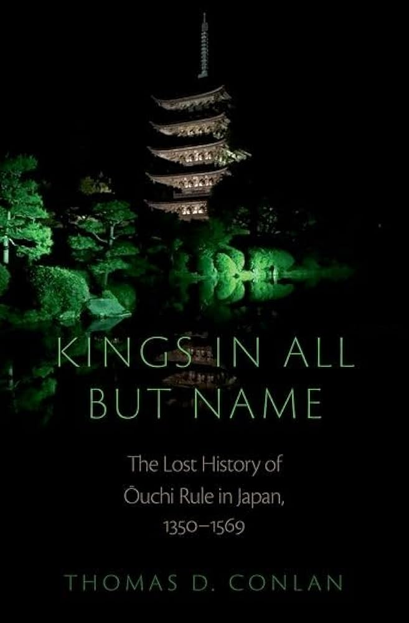
If you are looking for a good new book to help you teach pre-Onin War Japan may I recommend Thomas Conlan’s Kings in All but Name: The Lost History of Ouchi Rule in Japan, 1350-1569?1
I should perhaps mention that I don’t really teach this. The closest I come (now that we no longer have Rice Paddies ) is the bit before the three unifiers in my Early Modern Japan class. In the past I have done this with Mary Elizabeth Berry’s The Culture of Civil War in Kyoto.2 and the two Eiko Ikegami books The Taming of the Samurai: Honorific Individualism and the Making of Modern Japan.3 and Bonds of Civility: Aesthetic Networks and the Political Origins of Japanese Culture.4 Needless to say I don’t have the students read those, since they are too long and complex for this part of the class. I do have them read a bit of them and then steal a lot from all three of them. All of them work well in that they make good points and have lots of cool examples you can draw on in class to engage their interest and make yourself look smart.
Conlan’s book is perfect for this. He is looking away from Kyoto, at the Ouchi of Yamagata who were involved in national politics but also local power struggles and international trade ( see, Japan is not so isolated.) They were good enough at it that there are a lot of records on them, and (this being Japan) a ton of secondary stuff. He has been working on this project since 1995, so he has gone through all of it and there is a ton of interesting stuff in here.
For that reason, it is not a very good book club book. Besides costing $120.00 in print and $109 on Kindle, it assumes you know a lot 5 about the history of the period and its politics and culture and cultural politics. There is surprisingly little fighting in this book about a family of warlords by a military historian. The various leaders of the family run together a bit, so the book does not really work as a “behind the music” rise and fall thing. There is also maybe not quite enough on things like why patronizing shrines or writing poems on landscape paintings was important for undergrads to grasp these things on their own. On the other hand, if you can explain these things, and want cool examples, Conlan has you covered. If you want to talk about the importance of genealogy for elite clans and how flexible it could be, you can talk about the Ouchi’s supposed descent from the mythical Korean King Imseong (tying them to Korea ethnicity, kingship, and trade) and how they transitioned to claiming descent from the North Star Myoken Great Bodhisattva.
If you want to explain the importance of foreign trade, you could point out that a single tribute ship could turn a profit of 1,800 kanmon. This would be the equivalent of the tax revenue of a province, or the price to buy a lucrative estate outright. One kanmon would buy you an ox, or half a horse.6 If you want to dig deeper, Conlan and his footnotes will help you explain the improvements in copper mining in Japan, and the role of the Ouchi in sending raw copper to the continent, bringing coins back, and establishing the value of coins.
Establishing the value of currency is something you would expect a sovereign to do, and the book has a lot on the Ouchi and their relationship with the Ashikaga shoguns and the capital more generally. The most spectacular is their attempt to steal the Ise shrines. These were burned in 1486-7, and since the Ashikaga could not afford to rebuild them, Ouchi Yoshioki brought the kami of the imperial line to Yamaguchi.7
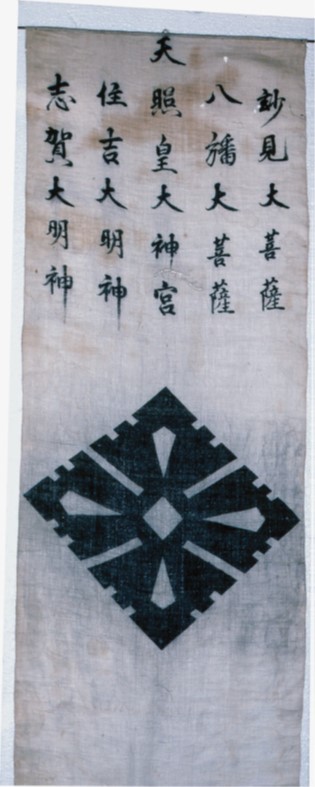
There is actually quite a lot in here about religion, since connections with shrines/temples and monks were a key part of politics. This is often hard to explain to students. Since there is a lot in here about how the Ouchi “patronized” ….Buddhists and Shinto8. It is rather obviously tied to geography. This battle flag not only has the Ouchi mon, it lists the shines they are associated with, and thus the areas they are connected to.
Even better, if you like teaching with images, is this.
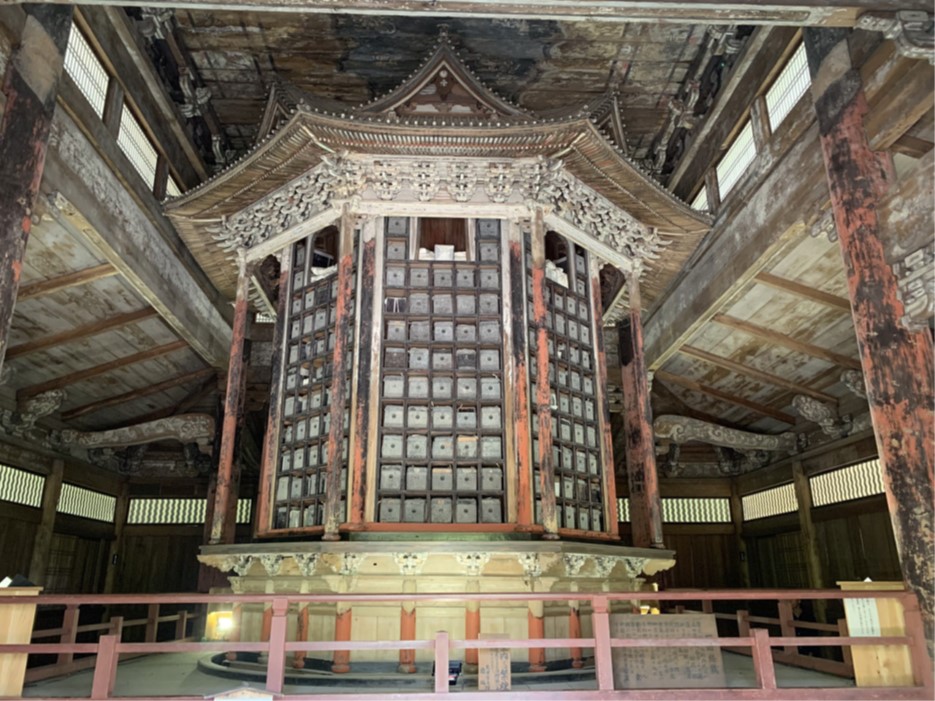
This is a copy of the Tripitaka, the Buddhist Canon that the Ouchi got from Korea, gifted to a Japanese temple, and then provided financial support for it to be recited twice a year both for the benefit of the listed patrons9 and for the benefit of the entire realm. Patronizing religion, foreign connections, usurping the role of the capital.. this book has it all.
Oxford University Press, 2024. ↩
University of California Press, 1997. ↩
Harvard University Press, 1995 ↩
Cambridge University Press, 2005. ↩
Well, not a lot a lot. I understood it. ↩
pg. 251 I assume lots of people who teach this could come up with their own examples, but I found it useful. ↩
pg.374 ↩
I will explain all that in a later class. Just relax. ↩
Ouchi and others ↩
