The Qing was quite the Early Modern state, with considerable ability to do things and collect information about how well it was doing. The disastrously expensive campaigns to put down the White Lotus Rebellions 1794-1804 are usually cited as the turning point where the Qing’s ability to both make China legible and control what was going on began to decline rapidly.
If you have to teach about this, and need a couple of good quotes about the problems the Qing had with understanding what was going on, controlling its own subordinates and paying for it all, then Dai Yingcong and Wang Wensheng have you covered.
Raising militias was always problematic for Chinese states, and Dai has a good quote about this from a memorial sent to the Qianlong emperor.
When local officials hastily recruited [militiamen], believing the more the merrier, they let numerous homeless drifters, elderly, and youngsters fill the ranks. In addition, the sectarian bandits have developed extensive networks by teaching [their religion] from one place to another, which are difficult to detect. Therefore, it is impossible to ensure that there are no people in the militias who are wavering and to distinguish the good from the bad ones, as the latter may disguise themselves. . . . Even innocent villagers have gotten used to killing months after having taken up spears and bows and abandoned their own professions, and take pleasure in receiving stipends and food rations. Their superiors can award and encourage them but cannot discipline them. [I am] afraid that they may cause more trouble after the campaign ends if they are not resettled properly at the slightest negligence.
Qianlong replies :
“Mingliang’s opinions are right. But now we’re relying on the militias to put down the bandits. If we revealed a hint of our doubt of them, they would be suspicious and fearful, which would be serious. . . . Let’s try to deal with [the militias] when we win the campaign completely.”1
Once recruited they were expensive and hard to control, as the Jiaqing emperor pointed out.
“Once joining the state army, the have to obey detailed military rules. While as鄉勇 xiangyong, they are free to come and go. Moreover, they are often better paid than rank and file soldiers.”2
They were indeed quite expensive, getting 2-3 taels a month where regular soldier got only one.
Here is a nice graph from Dai Yingcong (pg. 375) showing the decline of Qing silver reserves.
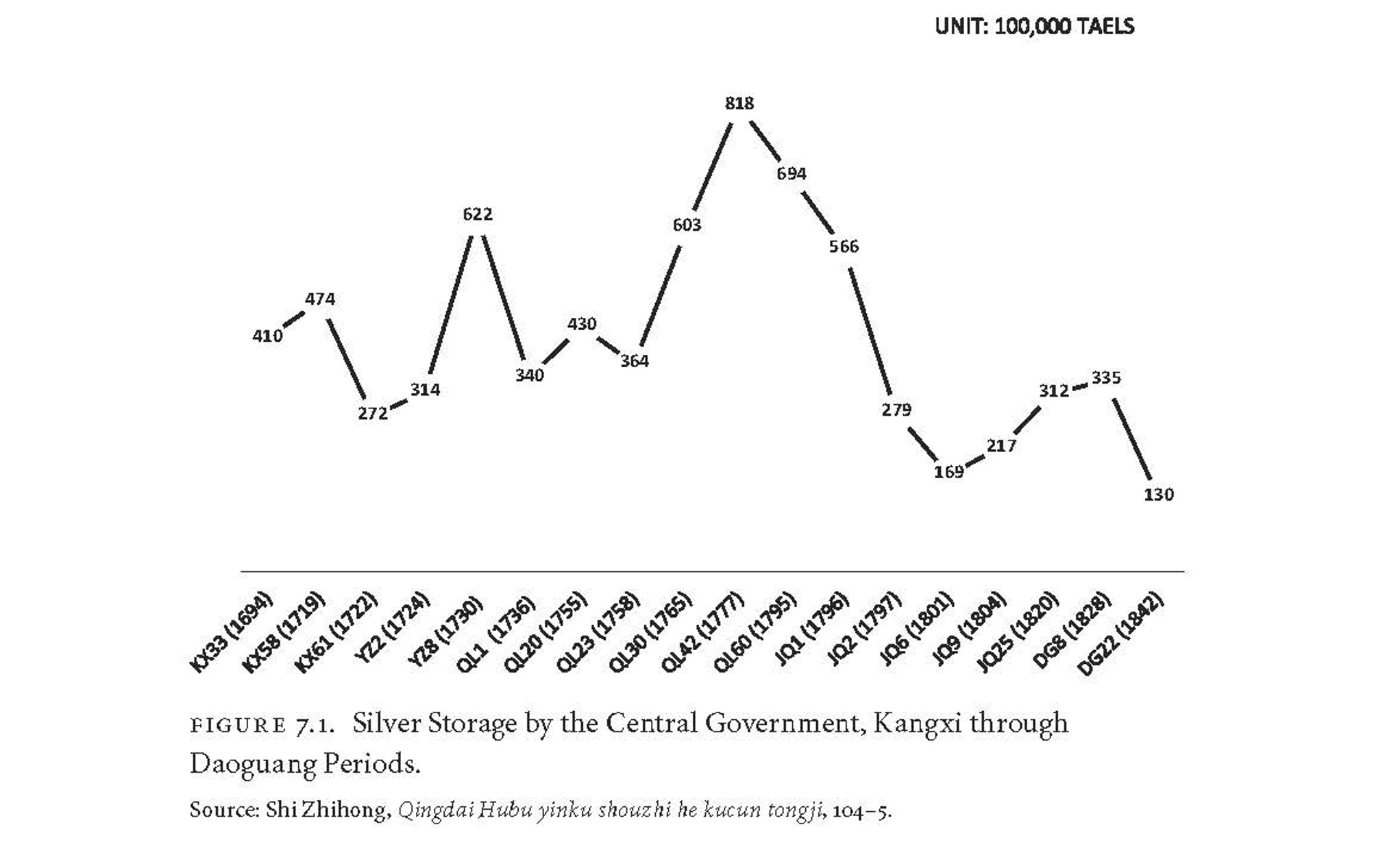
Jiaqing was aware of the crazy expenses for militias “rewards” for good soldiers, food etc. but
“As long as the rebellion is put down in a speedy manner, I can grant these dubious requests for funds and resources. All in all, it is better to to spend more to wrap up this campaign quickly than to cut costly outlays and risk dragging it on too long”…most “military spending has been dispersed in the society, so there is no need to worry too much about it”3
Dai, Yingcong. The White Lotus War: Rebellion and Suppression in Late Imperial China. 1st edition. University of Washington Press, 2019. pg 344 ↩
Wang, Wensheng. White Lotus Rebels and South China Pirates Crisis and Reform in the Qing Empire. Harvard Univ Pr, 2014. p 142 ↩
Wang, Wensheng. White Lotus Rebels and South China Pirates Crisis and Reform in the Qing Empire. Harvard Univ Pr, 2014. p 144 ↩
