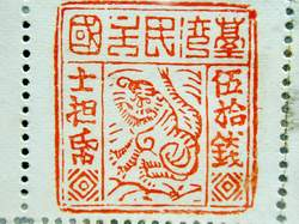
If you want to teach about the rapid spread of “modern” ideas in China after the Sino-Japanese war, the 1895 Taiwan Republic is good to talk about. Basically, when Taiwan was supposed to be handed over to the Japanese under the terms of the Treaty of Shimonoseki, there were attempts to create a Republic on Taiwan. 1 There was at least some rhetoric about modern ideas of popular sovereignty. ” An official seal has been cut, …it will be publicly presented with all respect by the notables and people of the whole of Formosa”2 although they also did not deny Chinese sovereignty. They issued postage stamps!
“
There was a picture of them in Dianshizhai huabao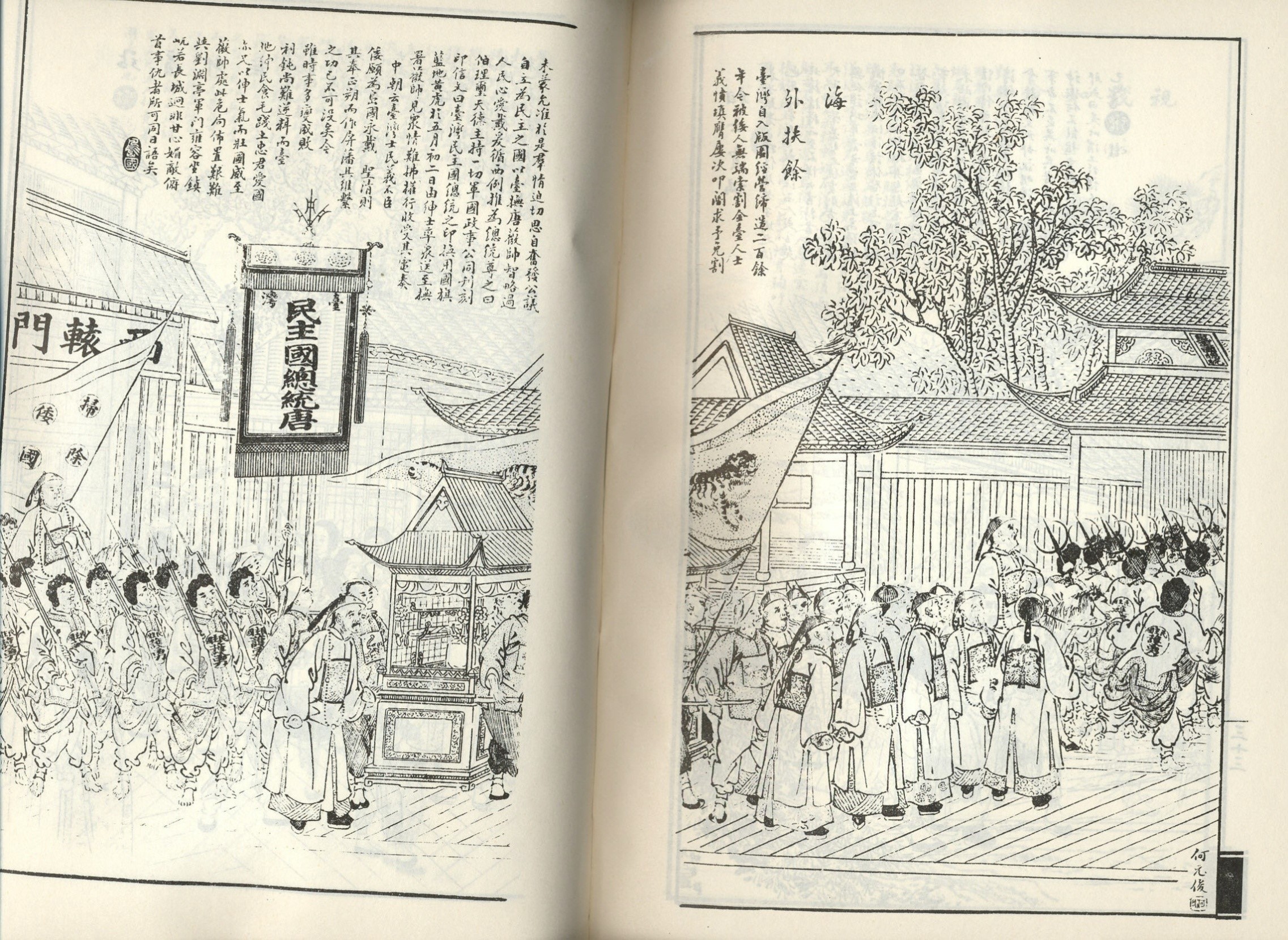
The images that really interest me are below, however
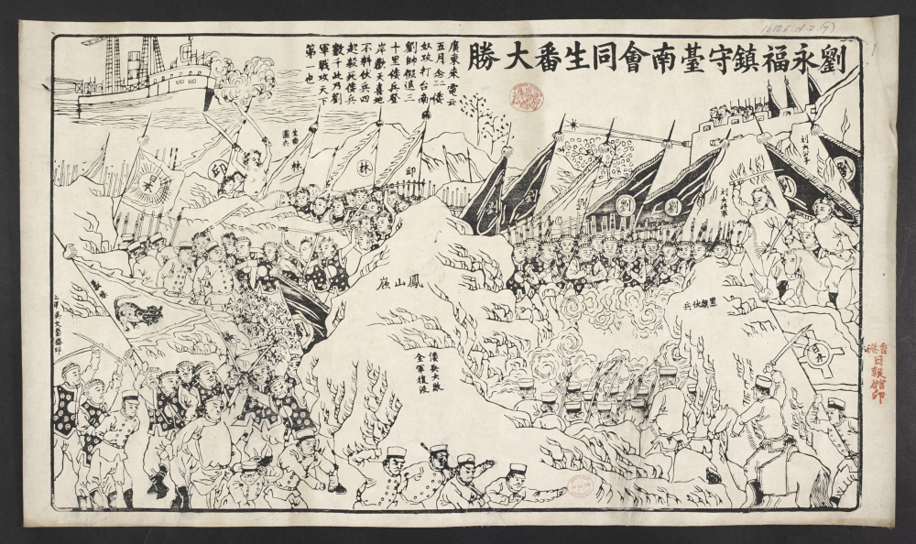
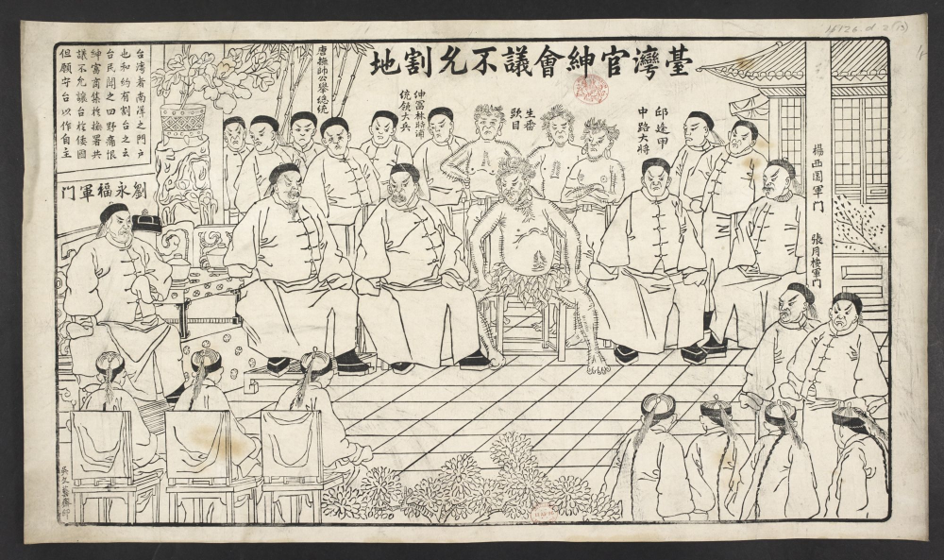
These are apparently both in the collection of the British Museum, but without any attribution. The first has a red stamp in the lower right that suggests it may have been from the Hong Kong Ribao. Both claim to have been done by someone called Wu Wenyi, but I can’t find anything on him. The second one is particularly interesting, since Liu Yongfu (who led the Black Flags in the Sino-French war) is in it. He was actually there, and it makes a nice way to bring in the role of the Black Flags/Triads/Gowned Brothers in Chinese nationalism. There are also some aborigines. I don’t think there actually was any non-Han involvement in this, which makes me think the pictures might be later. (They certainly -look- at bit later) It would be interesting if they were already being that multi-ethnic in 1895. You could do a lot more with them in class with better attributions for the last two.
There is not much scholarship on this. Lamley, Harry J. “The 1895 Taiwan Republic: A Significant Episode in Modern Chinese History”. The Journal of Asian Studies. (August 1968). 27 (4): 739–762 is the only academic treatment I have found. Niki Alsford Transitions to Modernity in Taiwan The Spirit of 1895 and the Cession of Formosa to Japan Routledge 2017 looks at attempts to get the British to take over the island, although I have not seen it ↩
Davidson, James W. (1903). The Island of Formosa, Past and Present : history, people, resources, and commercial prospects : tea, camphor, sugar, gold, coal, sulphur, economical plants, and other productions. London and New York: Macmillan & co, pp. 279–80 via wikipedia ↩
