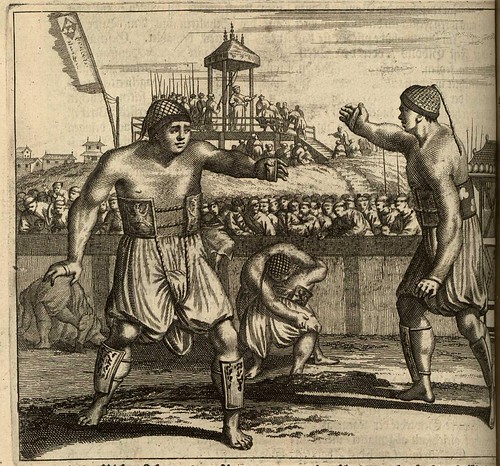
Like mixing water with water

Students often come to classes on China looking for the Timeless Wisdom of the Easttm As a historian I tend to dislike giving it to them, since the point of history is not to take wisdom out of historical context and apply it to your life.1 Still, I do like providing timeless wisdom when I can, and as we are talking about the origins of bureaucracy in China today I will be using this quote from the Zuo2 to talk about the difference between a minister and a toady. I suspect this will be one of the things that they can actually apply in their lives, if only as a great put-down.

Yan Ying on harmony and conformity

“Only [Liangqiu] Ju is harmonious (he) with me.”

[Yan Ying] answered: “Ju conforms (tong) with you; how can he be harmonious?”

The lord asked: “Are harmony and conformity different?”

[Yan Ying] answered: “They are different. Harmony is like a stew. Water, fire, jerky, mincemeat, salt, and plum [vinegar] are used to cook fish and meat; they are cooked over firewood. Then the master chef harmonizes them, mixes them according to taste, compensating for what is insufficient and diminishing what is too strong. The superior man (junzi) eats it to calm (ping) his heart.

It is the same with the ruler and minister. When there is something unacceptable about what the ruler considers acceptable, the minister points out the unacceptable in order to perfect the acceptability [of the ruler’s plan]. When there is something acceptable in what the ruler considers unacceptable, the minister points out the acceptable in order to eliminate the unacceptable. In this way the government is equalized (ping) and without transgressions, and the people have no contending (zheng) heart. …

As for Ju, he is not like this. Whatever you consider acceptable, Ju also says it is acceptable, whatever you consider unacceptable, Ju also says it is unacceptable. This is like complementing water with more water: who will be able to drink it? If the zithers and dulcimers were to hold a single tone, who could listen to it? This is how conformity (tong) is unacceptable.”

Zuo Zhao 20, cited in Pines 160-161


  1. Well, not the only point anyway 

  2. via Pines, Yuri. Foundations of Confucian Thought: Intellectual Life in the Chunqiu Period, 722-453 B.C.E. University of Hawaii Press, 2002.
     

North Korea’s engagement with the world

I remember the shocked look on my students’ faces fifteen years ago when I told them that we actually had no idea how decisions were made or leaders picked in North Korea, that it was more or less still a “black box.” I find it fascinating that we’re starting to get a better public picture of the internal processes of North Korea.

One of the reasons is the steady stream of refugees. In the Financial Times, Matthew Engel reports on a Korean enclave in the SW London suburb of New Malden. The relatively closed and self-reliant society is mostly middle-class, “bourgeois,” but among “the beginnings of an underclass” are North Koreans. I get the impression from the article that many of them are illegal immigrants, and their “underclass” status comes both from their lack of professional skills and their desire to remain outside of official notice.

Mitchell Lerner, at Ohio State University, believes that he’s found the key to understanding the Kim dynasty of North Korea: juche. And when “self-reliance” is slipping, domestically, they bluster internationally to bolster their credentials as strong and independent leaders. It’s counterintuitive: when they need help the most, they can’t get it. But their legitimacy as rulers is based on juche. He writes

In the political realm, it called for chaju (independence), in which North Korean leaders governed without constraint from outside pressure or internal challenge. Economically, juche called for charip (self-sustenance), which required a largely self-contained economy based on domestic workers using domestic resources to satisfy domestic needs. In international relations, juche advocated chawi (self-defense), a foreign policy based on complete equality and mutual respect between nations as well as the right of self-determination and independent policymaking.

Juche, simply, demanded the people subordinate themselves to the state, and the state in turn would advance their collective interests in accordance with the uniqueness and majesty of Korea, and always in pursuit of greater economic, political, and international independence.

By justifying the position of the suryong (single leader) and uniting the people behind him, juche successfully advanced Kim’s interests.

I’d call that a fairly textbook kind of fascism: emphasizing the independence of the nation, the subordination of the people to the nation, and the fuhrerprincip — the leader who embodies sovereignty. Even the reliance on the US as a hobgoblin echoes the “we have been denied our rightful place in the world” rhetoric of the early 20c fascist regimes. The only thing that distinguishes North Korea from them, really, is the longevity of the Kim dynasty. The Kim refered to in the above excerpt is Kim Il Sung, the founder of the DPRK; his son, Kim Jong Il, is one of the only examples I can think of of a successful fascist succession.

However, by closely associating the government’s legitimacy with its successful pursuit of juche, Kim had opened the door to potential disaster. When he triumphantly achieved juche, North Koreans would perpetuate and even embrace his rule. But if the pursuit was unsuccessful, the most fundamental justification for the regime would appear violated.

Legitimation of a government is always a double-edged sword. Some forms of legitimation have a sharper back edge than others: the Confucian Mandate of Heaven is like this, as well.

When considered within this framework, Kim’s tendency to behave more aggressively when he seemed to be at his weakest makes sense. Unable to deny economic and political instability that suggested his government was not acting in accordance with juche principles, Kim redoubled his efforts to demonstrate his strength and independence in the third juche realm, foreign policy.

He does a nice job fitting the periods of economic trouble with the eras of international tension. He also does a good job illustrating the claustrophobic environment — the limited, controlled media, the cradle-to-grave indoctrination, the purges, etc — which makes North Korea such a surreal place.

Update: Speaking of Surreal, Curzon has a post on Reverend Billy Graham’s relationship with North Korea, starting with his missionary ancestors. [via

Dutch Futurists

Alan Baumler pointed me to peacay’s recent post of Dutch images of 17th century Japan. Some of them are quite accurate — the images of samurai, in particular, are quite nice — and based on the observations of Dutch traders and scholars at the Deshima trading station in Nagasaki harbor. Some of the images are based on Indian or Chinese models (though the tradition of religious statuary shared between these cultures means that they’re not as terrible as you might think). Some are pretty bizarre, but that’s par for the course before the 19th century.

Then there’s the one that stopped me in my tracks:

17c Dutch Engraving of reverse rickshaw

You can find the original here, in the full context of the book. Someone who reads 17th century Dutch might be able to help me, because I’m quite curious about the text at this point. Without it, though, I can only speculate.

What’s wrong with this picture? Well, mainly the fact that the jinrikisha wasn’t invented for another two hundred years. Also, Japanese did not use wheeled carts for transporting goods.1. Before that, Japanese traveled mostly by foot and by boat. Samurai travelled by horse, sometimes. Other elites — including samurai, nobles, village headmen, the wealthy — traveled by palanquin (aka litter). Even the transport of commercial goods was mostly by boat and by hand.

While there seems to be some dispute about the origins of the rickshaw, nobody has ever suggested that it developed in the 1600s! I suspect what we see here is a failure of imagination. Having seen images of palanquins and bearers, but unable to concieve of transport without wheels, the illustrator added the — to him entirely obvious and necessary — elements. In the process, he created a shocking anachronism, and if anyone had taken these images seriously, could have radically altered the history of transportation.


  1. Hal Bolitho called Japan’s abandonment of the wheel one of the great mysteries of Japanese history, along with the failure to adopt the chair and the survival of the Imperial institution  

Making China democratic

Over at A Ku Indeed people have been discussing Bell’s East and West, which is an attempt to create a dialogue between Western and Eastern concepts of rights. I have not been that impressed with the book, but Chris had an interesting post on Bell’s final suggestion, that the way to democracy in China is to protect the nation from the dangers of giving the vote to the uneducated masses by creating a “House of Scholars”  to balance the passions of the masses. I found this idea unsatisfying at first glance, but I have been struggling with why.

Continue reading →

Liveblogging the Boxers

Military historian David Silbey is going to be blogging through the Boxer Uprising as seen through the New York Times. Though this is a little more of a distant view than Brett Holman’s Sudenten Crisis, I’m really looking forward to it. I’ve used Paul Cohen’s History in Three Keys and read a few other things that touch on the Boxers, but the one perspective I’ve never really mastered is the Western one. And the Boxer Uprising was a critical one for the image of China in the 20th century, one of the few events in Chinese history about which people know something. The first post in the series just went up; if you fall behind, you can survey all of Silbey’s posts here.

A Dictionary that Could Change your Life

I see a lot of passing on of digital tools, and a fellow Fulbrighter sent along this link, a Chinese dictionary where you can write in the characters and it looks them up for you. I find it especially helpful for looking up strange characters in names while writing bibliographies. So for those too lazy/poor (like me) to buy a pocket dictionary that has the features, this will save you the trouble of ever having to look up a radical again.

The Relaunching of Sino-Japanese Studies

I wanted to post a plug for a project that I have been involved with recently:

Announcing the relaunch of Sino-Japanese Studies online

For fifteen years Sino-Japanese Studies (1988-2003) was published in hard form and distributed throughout the world. It was the only journal of its kind in content, bringing together Chinese and Japanese studies—irrespective of discipline or time period. The relaunched journal will be available open access online and will continue to be the only journal of its kind. It will contain original, refereed articles, translations, reviews, and news from the field. Interested readers and contributors may find further details on making submissions to the journal as well as access the full online archive of back-issues at:

http://chinajapan.org/

They may also contact the editor directly.

Joshua Fogel (fogel at yorku.ca), editor (傅佛果, ジョシュア・フォーゲル)
Konrad M. Lawson (konrad at lawson.net), web technician (林蜀道, コンラッド・ローソン)

Note: I have announced the availability of the full archive of back-issues here before, but now we are restarting the journal and accepting new submissions.

The Relaunching of Sino-Japanese Studies

I wanted to post a plug for a project that I have been involved with recently:

Announcing the relaunch of Sino-Japanese Studies online

For fifteen years Sino-Japanese Studies (1988-2003) was published in hard form and distributed throughout the world. It was the only journal of its kind in content, bringing together Chinese and Japanese studies—irrespective of discipline or time period. The relaunched journal will be available open access online and will continue to be the only journal of its kind. It will contain original, refereed articles, translations, reviews, and news from the field. Interested readers and contributors may find further details on making submissions to the journal as well as access the full online archive of back-issues at:

http://chinajapan.org/

They may also contact the editor directly.

Joshua Fogel (fogel at yorku.ca), editor (傅佛果, ジョシュア・フォーゲル)
Konrad M. Lawson (konrad at lawson.net), web technician (林蜀道, コンラッド・ローソン)

Note: I have announced the availability of the full archive of back-issues here before, but now we are restarting the journal and accepting new submissions.

Starting a new year

As is something of a tradition here, these are my syllabai for the upcoming semester.

East Asia

Early China

Honors College Unit C on bronzes and classical China

Nothing here is terribly new, other than the bronzes thing.  The Early China thing may change a bit as the Chinese Text Project continues to develop, and it becomes easier to give them chunks of primary sources that you pick out without having to make them spend a lot of money.

Meet the meat

Foreigners have two contradictory images of “Chinese men”. One is the effeminate scholar with long fingernails and the other is the kung fu dude. This actually parallels real Chinese culture pretty well, where there has long been a tension between literati culture and the world of rivers and lakes.
Lu Buwei11 4/4 has a nice story to illustrate both literati fascination and contempt with the heroic redressers of wrongs..

Among those fond of bravery in Qi, there was one man who lived in the eastern part of the city and another who lived in the western part. Eventually they met on the road and said, “Shall we have a drink together?” After several rounds, they said, “Shall we look for some meat?” One of them said, “You are meat and I am meat. Why should we go seek meat elsewhere?” They thereupon soaked each other in sauce, then pulled out their knives and ate one another, stopping only when they had fallen over dead. It would be better to lack bravery than to practice this sort of bravery.

not much else to say, really.

A crack in the firewall?

The Chinese firewall seems to be acting up. On Saturday, authors of the New York Times, Washington Post, CBS and other newspapers I’m sure noted that the Times have once again been blocked by the Great Firewall. Some posited guesses as to why, perhaps it was a “controversial” article published in the International Herald Tribune about China’s impending economic problems. Perhaps it was the Chinese government reasserting control after they loosened up for the Olympics. No one knew. Ironically, this happened at the 30 year anniversary of the gaige kaifang, which editorial writer Nicholas Kristof pointed out

For some reason, now, it is unblocked, which the Times celebrated today. The article claims that no one in China knew why it was blocked for a few days. I know that China makes mistakes, but this seems a bit too sloppy for the government and their firewall. I admit, I don’t know a whole lot about the firewall, but this seems like a pretty big goof up to just “happen” for nearly 4 days. Not that a whole lot of people in China read the New York Times, but a lot of expats do, and I assume that the government knows how much it would irritate the Western powers who want to see more human rights in China, not fewer. Maybe it was all these Western papers getting upset about it that caused them to reverse their decision. Or maybe it really was a mistake. I’m not sure.

I like sex better than bear paws

Over at A Ku Indeed people, including myself, have been discussing Daniel Bell’s East Meets West which looks at the importation of foreign concepts of human rights into East Asia. So far I have not been that impressed with the book and one of the reasons became clearer to me when I found a review of Bell’s more recent book “China’s New Confucianism: Politics and Everyday Life in a Changing Society.” via CDT

One thing that bothered me is that he seems to be using the word “Confucianism” to mean “traditional Chinese culture”, which I find to be sloppy. More importantly, I find his reading of Confucianism to be…odd. Apparently  part of the book is about Karaoke bars as part of the modern Confucian culture, since Confucians saw music as having a vital role in creating a proper society. From the review.

It is within the karaoke bar that the bonding properties of music – so beloved of Confucians – become manifest. If the hostesses offer sex as well as harmonious conversation, that too is as the Sage Master might wish. “I never met anyone,” he told his 5th-century BC students approvingly, “who values virtue more than physical beauty.”

Wow. Chinese Text Project translates it (9.18) differently 子曰:“吾未見好德如好色者也. The Master said, “I have not seen one who loves virtue as he loves beauty.” Almost all the translators I have looked at either read this as Confucius criticizing people for liking sex over virtue, or as recomending you to pursue virtue with the same eagerness you pursue sex (Brooks). Where is Bell’s reading coming from? I suppose if you totally ignored the Confucian dislike of sexual licentiousness you might be able to come up with this. You would also have to ignore all the Confucian stuff about how music is not -good- but –powerful– and that music can both inspire virute and inspire bad behavior. (Such as sex and excessive drinking). There are lots of ways of explaining the sex culture of China, but I would not think of Confucius as being one of them. Has anyone read this book? Is it really as bad as the review makes it look?

Flithy Asians

One of my colleagues recently passed on his copy of The Far East by James H. Maurer Sentinel Printing, 1912.

The author says that the book is not the product of extensive research, and that is is mostly a compilation from other sources. At the time it was written Maurer, formerly a member of the Knights of Labor was a Socialist member of the Pennsylvania Legislature. In 1912 he became  President of the Pennsylvania Federation of Labor and in 1928 Socialist candidate for Vice President of the U.S.

The book itself is fascinating, as its main purpose seems to be creating a left-wing understanding of East Asia (mostly China). Thus there is a lot about opium and foreign capital’s attempts to exploit the Chinese, making the book radically more pro-asian than anything that would be published in the West for a long time. You also get a lot of zombie errors and  standard orientalism. Thus it is worth reading if you are interesting in attempts to create a left-wing understanding of the world or if you are interested in understanding foreign images of Asia from outside the standard elite sources.

One of the thing that jumped out at me was a quote from William Bancker of Springfield Mass., writing to the head of the Cigar Makers’ Union. Mr. Bancker is worried about the competition to American labor from cheap Asian cigars, and thus, in a very modern way, sees himself as in competition with Asian labor rather than in sympathy with it. Apparently the elite/labor split over relations with the non-white world goes back aways.

“I served two years in the Philippines in the army, mostly around Manila, and out of curiosity I visited a number of shops there. Now every solider knows the uncleanliness of the average Filippino, and if you ask him he will tell you that many a poor fellow came home in a box by too close association with them as they are poison to the white man. They are affected with a skin disease, and a large majority of them are covered with open sores or scars. Leprosy, beri-beri, cholera, beubonic plague and other infectious diseases, are, as everyone knows, prevalent there. They sit half naked and work and scratch, while the air is rank with the smell of decayed fish and rank cocoanut oil which the women use on their hair.  Now, imagine one of these natives, whose teeth have rotted black by the constant chewing of the betel-nut, biting out heads, which I took particular notice to see if they did, and using their spittle to help past the heads on their work, and you can form some idea of what the American smoker will get when the trust dumps these far-famed Manila cigars on the market. The United States government spends thousands of dollars to quarantine against these Asiatic diseases and when one leaves the island for this country, himself and all his effects are thoroughtly disinfected, and in the face of all this our law makers propose to put their seal of approval on this bill which will put in the mouths of thousands of citizens, a most prolific contagion, and if as I fimrly believe, it will be the means of infecting those filthy Asiatic diseases into the blood of the American people the present administration can thank itself for that. “

Mastodon