Historians have been very interested in World’s Fairs, international exhibitions and such for a while now. This is in part because of Gellner and Anderson’s ideas about nationalism, and above all the idea of a nation as an imagined community. Looking at a country’s exhibit at some sort of international do is a quick and easy way to figure out what their imagined community is, or at least what the people responsible would like to claim that it is to an audience of foreigners.
We are in the run-up to one of these events now, the Beijing Olympics. Lots of people (including lots of people in the Chinese government) are aware that this will be China’s big moment of exposure, and they are trying to spin how China will be seen long before the first shot is put. China Rights Forum has a whole issue out on it on this which can be found on-line here I liked Chen Kuide’s essay where he hopes that the Beijing Olympics will end up like the Seoul Olympics, where international attention may have helped the democracy movement, rather than like the Hitler Olympics where the Olympic movement served to validate the power of one of history’s greatest monsters. Even more interesting was Xu Jilin’s essay The Making of a True Athletic Superpower Xu contrasts the current Olympics with what he saw in Vancouver in 2004.
Asian History Carnival #17
Welcome to the seventeenth Asian History Carnival. The next carnival will be held December 12th. If you are interested in hosting the next carnival, please send me an email: kmlawson at froginawell.net.
Thanks to everyone who submitted nominations, the diversity and quality of postings in this carnival depends on them!
Continue reading →
Non-commercial emotion
James Fallows recommends the Shanghai Propaganda Poster Art Center. At least as a web museum it is not as good as Stefan Landsberger’s I did find the introduction (English only, apparently) interesting
ach poster exhibited here is a piece of art with history when all the people in China sacrificed for the greatness of one person. Mao Zedong ruled over China from 1949 to 1976. He turned around a quarter of the globe population in continuous political movements, especially in Culture Revolution, to fight with each other physically or mentally. The traditional Chinese philosophy and morality was abused. The sky and earth turned upside down. Nightmare came to its end at last as Mao died in 1976 and the civilization of China survived. The propaganda posters presented here tell you all these stories.
Today China is on the right track for prosperity again. Shame will it be to forget the recent past. Our purpose and responsibility is to help people understand the process of the rebirth. Long live the great Chinese people and its civilization. From art viewpoint, many of these pieces are great art works created by none commercial emotion. Time is changed and such kind of art could not be repeated. They are so limited and very hard to be found now. The value will be tremendous in the future.
We are very proud to have the best collection of this kind in the world and we are serious to prepare for a special museum in Shanghai for the education of the younger generation as well as being the destination of the foreign visitors.
The one thing that jumped out at me was the point that these were “created by none commercial emotion” but their “value will be tremendous in the future” In China as it lots of other places the relation between Art and Money has long been a complex topic. If for some reason you wanted to say something nice about the Mao period you could point out, as here, that it was less commercialized and money-grubbing than, say, the China of today.
Book stuff
Once again it is time to ask questions about books. Order forms for the Spring are due, so I need to figure out what I want to order. Thus I am asking for suggestions.
The courses for spring
History of East Asia aka Rice Paddies
Ebrey for a textbook. For books I was thinking of using Sei Shonagon’s Pillow Book (Has anyone looked at the new Penguin translation? Is it as good as Morris? Morris is expensive) The Shaddick translation of Travels of Lao Ts’an and Katsuei Yuasa’s Kannani and Document of Flames: Two Japanese Colonial Novels (Has anyone taught this? How did it go?)
As you can see there are no monographs in here (not that I am opposed to them in a sophomore class, but I tend towards more literary stuff.) Any suggestions of substitutions that would fit the pattern are most welcome.
Modern China (Which goes back to the High Qing)
No text, I think, as much as I like Schoppa’s text and as much as notext makes me nervous. Instead Kuhn Soulstealers (Almost too early for this class, but it works so well.) Baumler Modern China and Opium (Sort of subs for a text, as it reprints a bunch of primary sources that cover a lot of the issues of the period. Plus the deathless prose of the introductions will cause all my students to go out and buy 300 copies for their friends.) Reed Gutenberg in Shanghai: Chinese Print Capitalism, 1876-1937 (This one makes me nervous. I loved it. Some labor history, some politics, some intellectual history. Will it work for undergrads? Maybe Schoppa’s Blood Road instead?) Finally Gilley Model Rebels: The Rise and Fall of China’s Richest Village (I suspect there are any number of reform-era books that would work, but this jumped out at me )
Bonus course
I also have two sections of Introduction to History, our methods course for undergraduate history majors. As always I will be leading them through a monograph, in this case Cohen History in Three Keys on the Boxers and we will of course watch 55 Days at Peking I think we will also do some social annotation work with Diggo, which allows you to do social annotation on any web page. Any suggestions on readings, or primary sources on the Boxers that are on-line or that I could put on-line are very welcome.
The good helmsman
With double ten around the corner it seems a good time to discuss the vexed question of who was China’s greatest leader.1 Via ESNW we learn that at least in Taiwan the answer is Chiang Ching-Kuo.

Almost half of respondents called him Taiwan’s greatest President, 77% said that his positives outweighed his negatives, and a mere 4% said the opposite. For all those who have spent many hours debating if Mao was 60% good and 40% bad or vice versa these are pretty impressive numbers. Double ten would be a great day to raise a glass of vodka in honor of one of the great heroes of democracy in Asia.
In keeping with the spirit of the holiday only democratically elected leaders may apply ↩
Controversy over the origins of the Japanese schoolgirl sailor uniform
For years private girls academy Fukuoka Jogakuin in Kyushu has been credited with first introducing in 1921 the famous sailor-style uniform worn by so many middle-school Japanese girls. However a recent investigation by a uniform manufacturer preparing an exhibit on the history of Japanese school uniforms has unearthed photographic evidence that Heian Jogakuin in Kyoto introduced a uniform with a sailor-style flap one year earlier, in 1920.
The debate has heated up, with both schools insisting that they were the first and that the other schools claim is invalid. At a time when declining numbers of Japanese children are forcing private schools to become increasingly cuthroat in their competition for students, having an awesome uniform with a storied past is seen as a way to attract students.
While it seems incontrovertable that the Kyoto school had the sailor flap first, their uniform was an unsightly, shapeless one-piece, where as the Fukuoka school’s uniform is clearly a precursor to the style still in use today, so maybe both schools have a reasonable claim.
Source: セーラー服:発祥論争 平安女学院VS福岡女学院 (毎日新聞)
Asian History Carnival Coming October 10th
I just wanted to announce that we will be hosting an Asian History Carnival at the Frog in a Well: China weblog on October 10th. Read more about the Asian History Carnival and how you can nominate posts for inclusion here. The carnival will include excellent weblog postings on Asian History written since August 8th, along with some related online resources. You can also easily recommend nominations by tagging them on del.icio.us with the tag “ahcarnival” (http://del.icio.us/tag/ahcarnival/).
Asian History Carnival Coming October 10th
I just wanted to announce that we will be hosting an Asian History Carnival at the Frog in a Well: China weblog on October 10th. Read more about the Asian History Carnival and how you can nominate posts for inclusion here. The carnival will include excellent weblog postings on Asian History written since August 8th, along with some related online resources. You can also easily recommend nominations by tagging them on del.icio.us with the tag “ahcarnival” (http://del.icio.us/tag/ahcarnival/).
Asian History Carnival Coming October 10th
I just wanted to announce that we will be hosting an Asian History Carnival at the Frog in a Well: China weblog on October 10th. Read more about the Asian History Carnival and how you can nominate posts for inclusion here. The carnival will include excellent weblog postings on Asian History written since August 8th, along with some related online resources. You can also easily recommend nominations by tagging them on del.icio.us with the tag “ahcarnival” (http://del.icio.us/tag/ahcarnival/).
More on public history
I posted a while back on how the Chinese are more aggressive in re-building historical sites than one would expect in the West. Angela Zito explains some possible the reasons for this. Cities were architectural representations of the harmonious order the emperor was imposing on the cosmos, and thus re-building them was one of the things emperors did.
the building and rebuilding of the city also actuated again and again in the act of construction the cosmic principles of the city’s design. Thus a new dynasty inevitably signaled the emergence of order from chaos by building projects. Later, the continuous “restoration” (xiu) of the architecture of one’s fore bearers combined filial respect with sagely rescue of pattern from decay. (p.133)
In a footnote she claims that the government of the PRC thinks like this and their “notion of preservation ..emphasizes the metaphysical whole of a building rather than its material parts. As long as these are faithfully reproduced in situ, guidebooks and local people will inevitably report that the building is ‘original'” I think this is an interesting insight, but I’m not sure I entirely agree with it. I think she is right in saying that re-building was important traditionally because it displayed the ruler (or the local elite) as creators of cosmic order. To just leave things alone was to leave them in the past, and since these things are not yet museum-ized in China (to use Levenson’s term) you almost have to fiddle with them.
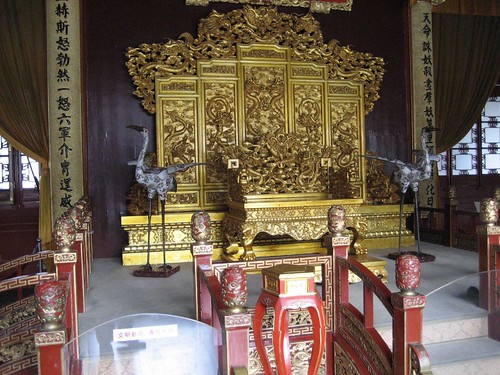
I’m not sure that something has to be in situ or all that faithfully reconstructed. To some extent this is true of any site anywhere. Mount Vernon has been painted any number of times since Washington died, and I suppose that other than the main timbers most of the wood has been replaced. If authority says this is it than this is it, for most purposes. This is the throne of the Taiping Heavenly Kingdom in Nanjing

I know of no pictures of what the Taiping throne looked like, and I am sure that not a single ounce of wood in this thing is “authentic” and yet here(Nanjing) it is. I wonder if part of what encourages this manic reconstruction is, as Zito claims, a desire to make the state look like preservers of the patterns of the universe, or of this case the past. Given the Communists’ role in destroying so much of the fabric of China’s history they may feel that it is particularly important to reconstruct the past.
Our Japanese Comrades
Ding Mocun, Lung Ying-tai and Lust, Caution
Ang Lee‘s (李安) new movie Lust, Caution (色,戒) is apparently being released later this week in the United States. The movie won a Golden Lion at the Venice Film Festival (where it was labeled as coming from “USA/China/Taiwan, China“), received a full mix of reviews (1,2,3,4,RT), and may ultimately get an unusually limited showing due to its NC-17 rating. The version which eventually cleared censors in China supposedly had to cut some thirty minutes.
The movie is based on a novella by Eileen Chang (張愛玲)which in turn is inspired by an historical event: the attempted assassination of Ding Mocun (丁默邨 1903-1947) on December 21st, 1939 by the 22 year old half-Japanese spy Zheng Pingru (鄭苹如 1918-1940).
Ding Mocun was a leading figure in Chinese intelligence in the 1930s until his execution in 1947. He was a former Communist Party member who recanted and rose quickly to power in the Nationalist party with the support of the CC Clique and especially Chen Lifu (陳立夫). When he was squeezed out of power in a 1938 reorganization of the Nationalist intelligence services into the Zhongtong1 and Juntong2 and accused of corruption, he left unoccupied China and together with Li Shiqun (李士群 1905-1943) worked for the creation of a spy agency supporting Wang Jingwei‘s (汪精衛/汪兆銘 1883-1944) peace movement in Japanese occupied areas.3 The headquarters of the resulting organization, founded in April, 1939, was located on 76 Jessfield Road, Shanghai, and became a site of infamous torture and death often simply referred to in Chinese accounts as “#76” (七十六號). In its twenty or so holding cells Ding and Li’s operatives, along with Japanese officers, extracted what information they could from suspected Communists and supporters of the Nationalist government in Chongqing before dispatching them.
Ding is now usually listed among the dozen or so most famous Chinese traitors (hanjian 漢奸) for his collaboration with Wang’s government and the Japanese. He was arrested in September, 1945, convicted of treason in February 1947, and executed on July 5th.4 Like many of the leading collaborators put on trial after the war, however, Ding pleaded that he secretly cooperated with the Nationalist spymaster Dai Li (戴笠). Many of the other leaders in the Wang government, most famously Zhou Fohai (周佛海 1897-1948) also claimed be working closely with the Nationalists in great secret. This came to be referred as the argument of “saving the country through twisted means” (曲線救國, more on this at my personal blog, Muninn). With the arrival of a movie which is inspired by the story of Ding and the attempt on his life by Zheng Pingru, there has been renewed interest in his case.
Roland Soong, who runs the world’s best weblog covering the Chinese media, ESWN, recently posted a translation of an article by the famous writer and critic Lung Ying-tai (龍應台) discussing the new movie and the historical figure Ding Mocun: Lung Ying-tai on Lust, Caution
You can find the original Chinese version of her article here: 贪看湖上清风──侧写《色,戒》
In her essay Lung responds to criticism that Eileen Chang did not portray the character of Mr. Yi (who is inspired by Ding Mocun) as a sufficiently evil person. I certainly commend her for this, as I really don’t think Chang’s fictional character Yi needs to be everything that Ding Mocun was. However, many writers who try to counter efforts to portray the wartime collaborators as one-dimensional evil-dooers and malicious traitors, in my view, take the completely wrong approach: the reversal. Instead of restoring nuance, or at least moving beyond simple nationalist critiques to evaluate the legacy of these figures in terms of their acts while in positions of power (under whatever regime), Lung embraces a strategy I find frustrating, to say the least: the evil-dooer wasn’t evil at all, he was, in fact, a patriot.
小说和电影之外,民国史里头的“易先生”,其实也不见得是个多“坏”的“坏人”
“the novella and the film aside, the Mr. Yi in the history of the Republic of China was really not a very “bad” person.”5
Lung writes that she read through the archival materials related to Ding’s various positions in the regimes of occupied China and his trial records along with the memoirs of Chen Lifu.6 Lung argues that we should reevaluate the historical figure Ding because beginning in 1941 he 1) began to secretly work with Chiang Kai-shek’s government, 2) helped rescue some secret agents, 3) continued to serve the Nationalist government to repress bandits (read Communists) in the chaos of the immediate aftermath of the war and his work was highly valued both by Dai Li and Chen Lifu.
Continue reading →
Brian Martin, “Shield of collaboration: The Wang Jingwei regime’s security service, 1939-1945” Intelligence and National Security 20, No. 4 (2001): 100. 劉傑 『漢奸裁判』 (The Hanjian trials) (東京:中公新書、2000), 176 ↩
劉傑 ibid. ↩
All translations from the article are Soong’s ↩
Though she doesn’t use it, I think the full title of his memoirs is 成敗之鑑:陳立夫回憶錄 ↩
20th Century Chinese Women's History for Undergraduates…..
A blatant request for help1:
I’m teaching my 20th century China course in the Spring, and book order season is upon us already! Last time I taught it, I used Jung Chang’s Wild Swans: Three Daughters of China, with some success. But I’m not sure if I want to use it again. The discussion of her biography of Mao raised questions about the reliability of her earlier work — some implicit, some explicit — and I haven’t seen much to sway me one way or the other since then.
I am going to have to think about how I’m going to address the Mao question, too, but first and foremost I’d like to know if there’s anything out there which I could use with my students to address the basic questions of family, women, gender and life experience over the course of the 20th century?
I’ve read through this bibliography of Chinese womens’ history, and done some other looking around, but I really can’t find anything remotely comparable. I’m OK with using monographs or edited collections — it wouldn’t kill my students to wrestle with a little scholarship now and then — but I’m not finding anything that looks right.
Any thoughts?
Oy
Yes, its sort of dumpster-diving, but there is a really dumb post on Chinese history up from John Derbyshire. In the process of explaining why he is not quite Islamophobic as some of the other writers on NRO he points out that Islamic civilization is no more stagnant and pointless than that of, say, China. To prove this he cites this from an 1882 history of China.
It might be more instructive to trace the growth of thought among the masses, or to indicate the progress of civil and political freedom; yet not only do the materials not exist for such a task, but those we possess all tend to show that there has been no growth to describe, no progress to be indicated during these comparatively recent centuries. It is the peculiar and distinguishing characteristic of Chinese history that the people and their institutions have remained practically unchanged … from a very early period. Even the introduction of a foreign element has not tended to disturb the established order of things. The supreme ruler preserves the same attributes and discharges the same functions; the governing classes are chosen in the same manner; the people are bound in the same state of servitude, and enjoy the same practical liberty; all is now as it was. Neither under the Tangs nor the Sungs, under the Yuans or the Mings [i.e. from the seventh to the seventeenth centuries — these are the names of Chinese dynasties] was there any change in national character or in political institutions to be noted or chronicled. … This condition of things may be disappointing to those who pride themselves in tracing the origin of constitutions and the growth of civil rights, and who would have a history of China the history of the Chinese people … the fact is undoubted that there is no history of the Chinese people, apart from that of their country, to be recorded. The national institutions and character were formed, and had attained in all essentials to their present state, more than 2,000 years ago.
O.k., its John Derbyshire, who is a nut, but he is not entirely ignorant about China. He has a Chinese wife, and apparently speaks some Chinese, and appeared in a Bruce Lee movie. Is there any way of getting the general public to realize that China has changed in the last 2000 years?
Why Study?
Jeremiah from Granite Studio has post about the debate in American universities about the relationship between education and training. Anthony Kronman claims that American universities spend far too little time teaching students about the meaning of life and far too much time doing research and teaching people how to have successfully careers. Kronman claims that our reluctance to teach students the meaning of life has weakened the humanities and made us subject to “being hijacked for political ends” He is particularly hard on how America’s humanities faculty have ceded their position to those in the university who value research and careerism (which is sort of rich coming from the dean of Yale Law School) and longs for the return of the pre-1870 university with its single, coherent curriculum, clear moral sense, and lack of interest in either the German innovation of research or the modern American consumerist idea of students choosing their own majors. Lots of people in America talk like this, but I find most of this sort of rhetoric to be faux-nostalgic blovating. I actually think education as opposed to training is important, and I’m glad places like St. John’s, Wheaton College and Northland exist, and I’m glad many students at other schools learn things beyond preparing for a career, even if they were not planning on it. but I can’t imagine a national Ministry of Higher Education forcing the current American higher-ed system in a pre-1870 direction.
Jeremiah claims that looking at China is worthwhile when thinking about this (which I agree with), and Chinese intellectuals spent an awful lot of time talking about the purposes of education and above all the relationship between education as moral cultivation and education as getting and doing a job. In fact Chinese scholars talked so much about this I am going to limit myself to one figure, Zeng Guofan.1 Zeng one of the most important provincial officials of the mid-19th century and responsible for putting down the Taiping Rebellion and restoring the fortunes of the Qing dynasty. As patriarch of his family he also left a lot of writings about proper education and its purposes. Of course many of the educational debates of the Late Imperial period seem to have little contact with ours. The debate on the role of philosophy vs. literary skill, learning of the mind vs. learning of the heart, etc. all of these seem rather distant to us. Like Anthony Kronman, however Zeng thought education had two purposes, to advance virtue and to prepare for a vocation. In his case the vocation was government service and the gateway to government service was the exams and the 8-legged essay. The 8-legged format could be and was criticized for encouraging students to strip-mine the classics for clever tidbits they could toss into their essays. Some would say it was possible to have a good career without really becoming a good person. Zeng, of course did not see it that way, as he did not draw a sharp divide between exam learning and moral learning. The exams really tested your worthiness, in his view. If you could write a good 8-legged essay you were a good person, and fit for government work.2 If you were successful at learning it would help you even if you were not lucky enough to pass the exams and instead had to work as a private secretary or a teacher.
If the farmer works hard at plowing, there may still be famines, but there will surely be years of good harvest. If the merchant adds to his stock of merchandise, there may be times when sales are slow, but there will surely be times when the market in unimpeded. If the scholar is excellent in his vocation, how could it be that he will never obtain a degree? Even if he never obtains one, are there not other paths to livelihood? Therefore, the problem lies in one’s not being excellent in work.
If you did not want an official career, like his son Qihong, study became even more important as the road to happiness.
Since you are not interested in degrees and positions with emolument, you must read more of the ancient books. You should frequently hum verses and practice calligraphy so as to foster character an sentiment; there will be enjoyment in store for you for your lifetime and to spare
Our modern attempts to make students value study as a road to joy have not seen much success, and I don’t think anyone today sees a direct connection between moral education and landing a job. Zeng certainly did, and would have seen little point to a division between Gen Ed and a major, or worse still a multiplicity of majors. He did recognize the importance of specialization, but in an almost religious sort of way. One should start a text, and read through it carefully, stopping and re-reading any sentences that puzzled you until you understood them and then moving on. On should read only one book at a time. This is entirely different from the way we encourage students to approach texts. We encourage them to mine them for the information they want, molding texts to their purposes rather than assuming that texts are things that they should mold themselves onto
Zeng admonished his family to study, but backed up his words by continuing his studies throughout his life. Like most literati he practiced his calligraphy daily, and throughout the war years he continued work on his Random selections from the Classics, history and various writers. He apparently though that liberal study was part a life-long process of self-cultivation, which is not usual with us. I rather doubt Anthony Kronman is showing up at the freshman seminars at Yale in hopes of becoming a better person and dean.3
This is just China, of course, but I think the Western model of education before 1870 has a lot in common with this. You really can’t have meaning of life education without a common agreement on what the good life is and a society which values those who have learned about it. We just don’t have that and are not going to any time soon. This is a capitalist society, and universities sell what people want to buy Student demand drives what is produced in American Higher Ed, and will for the foreseeable future. I’m glad almost every college in America has some sort of baseline Gen Ed program (our concession to the meaning of life), and while I may disagree with how some of them are run, I also realize that liberal education is a poor sister to the football team and the Law School and always will be. American students will always be able to choose a major, rather than having the proper course decreed for them,
Ours is also at least rhetorically an egalitarian society, and it’s hard to see where the teachers for meaning of life education would come from. For Zeng Guofan this was not a problem. He increasingly came to be free of doubts, and was quite willing to set himself up as a sage, and in fact this was the point of traditional education. As Confucius put it, only the ren can love or hate others, i.e. the point of education is to reach the level where you are a superior being who can judge others. I for one would feel quite reluctant to grade students in a Meaning Of Life class. I can certainly assess how well students can explain the Self-Strengthening movement, or how well they write, but to award someone a B- in Meaning of Life would seem to be antithetical to most of what I think a faculty member should be. Not everyone thinks like this, of course. Nabakov’s vision of a college with “murals displaying recognizable members of the faculty in the act of passing on the torch of knowledge from Aristotle, Shakespeare, and Pasteur” is popular it its way with a lot of faculty but most of them seem to be people like Ward Churchill. Churchill is criticized for politicized teaching, and Kronman claims to oppose that, but I don’t see how you can square non-politicized teaching with knowing the meaning of life. Zeng Guofan certainly thought students were learning how to be better people outside the classroom and would have had no problem judging them on how they behaved outside class.
I think liberal education is important, and I am happy that so many of our students seem to be getting it despite our repeated failures to figure out what it is or how to teach it. I don’t think that abstract wishing for the pre 1870 world is much help, however. While we may draw on old ideas about education and the Good Life we have to think seriously about the context these ideas came out of and how we have to adopt them.
I will also limit myself to one source on him, Kwang-Ching Liu “Education for Its Own Sake: Notes on Tseng Kuo-fan’s Family Letters” from Elman and Woodside eds. Education and Society in Late Imperial China California U.P, 1994 ↩
Even Zeng came to doubt that the 8-legged format could embrace all knowledge, but he never became Wu Jingzi ↩
I could be wrong about that, of course ↩

