Help me pick some books

Book order forms for the Fall are on my desk again, and again I am going to ask for any advice people might feel like sending my way. The two Asia courses I am teaching are Modern Japan and Introduction to Asian Studies.

Introduction to Asian Studies is the tricky one. It is supposed to introduce our Asian Studies majors and minors to the study of Asia. I learned from my evaluations last time that some of them expect the class to cover all the societies of Asia from all possible disciplinary perspectives. I am a bit more modest in my goals and usually build the class around four or five books and a couple of movies that deal with several different parts of Asia from various disciplines.

The theme for this time will be “Protest and Dissent in Asia”  and I was thinking of using

-Multatuli Max Havelaar: Or the Coffee Auctions of the Dutch Trading Company Indonesia, colonialism, and it’s a novel!

-Apter and Sawa Against the State:Politics and Social Protest in Japan Japan and Political Science. Has anyone used this?

-Nir Rosen In the Belly of the Green Bird: The Triumph of the Martyrs in Iraq Iraq (obviously) and journalism. I like making them read something by a journalist, since they read a lot of journalism stuff anyway and should learn how to work with it. This title jumped out at me, but It has not arrived yet and I have not yet read it. Any other suggestions?

John W. Dardess Blood and History in China: The Donglin Faction and its Repression 1620-1627  China and history. I have my doubts about this. I liked it, but will it work for students? I like making them realize that the world existed before 1800, but this book may not work. There must be some biography or whatever of some pre-modern dissident that is out in paperback. Maybe do Keene’s Frog in a Well  and dump Apter and do something Poly-Sci ish on China, like Lee’s Against the Law: Labor Protests in China’s Rustbelt and Sunbelt?(really more Anthro than poly-sci, actually)

Basically, I am looking for good books that will stick with students. Any recommendations are most welcome.

For the Modern Japan class I am going to use a textbook and probably

-Walthall The Weak Body of a Useless Woman: Matsuo Taseko and the Meiji Restoration
The one stop shop for all your Late Tokugawa society, Meiji politics Gender and Economics stuff.

-Kawabata The Scarlet Gang of Asukusa looks very good, although I have not used it before. Has anyone tried this?

-Then something postwar. But what? I did Embracing Defeat last time and it worked o.k., although I think it was a bit too long.

Smoking in China

A good book answers your questions. A really good book answers questions you had not thought of yet. Apparently Tim Brook’s Vermeer’s Hat is a really good book, as it is already answering questions I did not know I had. Among the many topics Brook discusses (the book is about globalization in the 17th century) is the history of smoking. He points out that this was a new habit in China (and everywhere else) and he also talks about pipes. I had always known that Chinese pipes were rather long, both the tobacco pipes like this Baccyor thiswater

and the opium pipes like this

pipe

1 Brook explains that the reason for the long pipes is that smoking was considered a particularly yang thing, and you wanted to let the heat of the smoke cool (or de-yang) itself as much as possible. This is why smoking was not advised for women or old men, why women’s pipes were so much longer than men’s and, I presume, why cigarette smoking among women was considered so risque in the the 20th century.


  1. Note that when selling things on Ebay you can call them all opium pipes  

Images of Late Medieval Disease Critters and Meiji Toys

Japanese historical visual materials are becoming available online in increasing quantities and variety, as seen in two posts from the last week from Pink Tentacle and BiblioOdyssey. The former posted an entry titled “Mythical 16th-century disease critters” which introduces a text owned and published online by the Kyushu National Museum:

Harikikigaki, a book of medical knowledge written in 1568 by a now-unknown resident of Osaka, introduces 63 of these creepy-crawlies and describes how to fight them with acupuncture and herbal remedies. The Kyushu National Museum, which owns the original copy of Harikikgaki, claims the book played an important role in spreading traditional Chinese medicine in Japan.      

BiblioOdyssey’s post introduces a database of late 19th-century, early 20th-century water color depictions of toys. These seem to be by Koizumi Kawasaki (1877-1942): “Japanese Toy Design.” 

Add these to other resources like the Nagasaki University Library’s Metadata Database of Japanese Old Photographs, Database of Nationally Designated Cultural Properties and the Tohoku University Library’s Kano Collection – Image database.

'China Network' at Cambridge

If you will forgive the promotion, this may be of interest to other Frogs…

Cambridge University’s humanities centre (CRASSH) recently received funding for a two-year network on China, on the theme of modernity. Most of the scholars involved are approaching this from the field of comparative literature, but also there are historians and translation scholars. There will be conferences in Cambridge (this May), Yale (later this year) and Tsinghua (2009).

Some information is online here about the May conference http://www.crassh.cam.ac.uk/events/2007-8/chinaconference.html.

Three thoughts on Visibility

  • My favorite new blog Photoshop Disasters has a Korean Basic Instinct 2 poster in which Sharon Stone’s head has been altered from the US version: Cosmo7 cites the fact that the hair is wet, which is the photoshop ‘tell’ but can’t explain why they would do that. I suspect that the wet hair is a side-effect of needing a head shot that was oriented differently, that they wanted to shift Stone’s gaze away from the viewer, make her less …. well, here’s where my complete lack of exposure to Korean media becomes a liability. Either they want her to be less aggressive (which doesn’t entirely make sense, given the movie) or more aloof.
  • Dr. Virago and Dr. Crazy (Dr. Crazy’s analogy to Star Trek/Lost In Space/Heroes is worth the price of admission) among others, are having an interesting discussion about how scholars achieve “visibility” and “impact” both within their subfields and in the discipline. Their discussion doesn’t directly touch Asian Studies, but it does have some thought-provoking ideas for both young and feeling-marginalized scholars.
  • I just got my current Journal of Japanese Studies in the mail, and two of the three articles are about Korea: one about the development of the Korean Civil Code under Japanese protectorate and the other about middle-class Koreans in 1930s Japan. The latter is by an old grad school friend, Jeff Bayliss, who’s teaching a course combining Korean and Japanese history which is exactly the kind of thing I’ve been thinking about for a long time. I’m a little jealous, yes, but mostly I’m thrilled to see the crossover scholarship being taken seriously.

What if?

Geez, now everybody wants to play. On March 7 our own Charles Hayford started the ball rolling by posting on Five things that Didn’t Happen (But Might Have). This led to Michael Turton coming up with a list for Taiwan history. Now the New York Review of Books is getting in the act, with a piece by Perry Link entitled He Would have Changed China. It is a review of Zong Fengming’s book of conversations with Zhao Ziyang Link starts of with a few favorite Chinese history counterfactuals, like what would have happened to Lu Xun if he had lived past 1949, and then gets on to Zhao, who has also been a subject for these types of games. Link shows that during his years of house arrest Zhao did a lot of reading and came to the conclusion that China needed more democracy, more rule of law and less nationalism. He also concludes that Zhao would have probably had very little effect even if he had held on to power in 1989 and if his thinking had evolved in the same way. The real power was always with Deng Xiaoping and to a lesser extent Chen Yun. Still, lots of people in China like to imagine something that might have been better.

Conceptual art

Two pines


Several generations later, in Zhao Mengfu’s “Twin Pines, Level Distance,” something new appears. No more realism; no more romanticism; in a sense, no more painting. Now the landscape image is an extension of writing, a form of embodied thought, an essence of landscapeness, a text to be read. In the contemporary West we have a term for this: conceptual art.

With Asia Week in New York the NYT has a review of a show called “Anatomy of a Masterpiece: How to Read Chinese Paintings” There is a slide-show too! It looks like a nice show and a good book. Given some of the interest in connecting Chinese art to western traditions in the last post and the comments I thought I would post this.

Via HNN 

Conference at the Huntington Library

I’ve been wanting to write about a wonderful local resource, the Huntington, for a long time, but couldn’t figure out how to work it into a post. It is located in the wealthy town of San Marino, an interesting community just south of Pasadena. The Huntington (or, to use its full name, The Huntington Library, Art Collections, and Botanical Gardens), has one of the best archives in the country for British and American history and literature, 15th century European books, history of science, maritime history, and Renaissance exploration and cartography. The place has the manuscript collection of Jack London, for cripes sake. They also have an excellent research library that has a surprisingly large number of Japan-related items. In fact, the last time I searched under “Japan” I got more than 1800 hits – we’re not talking about Japanese-language materials, but still, some interesting things can be found. Their art collection, which focuses on British and French art of the 18th and 19th centuries, probably has some ripe examples of Japonisme, though I haven’t investigated.

Most fun, perhaps, is the Japanese garden, which Kendall Brown wrote about in his book Japanese-Style Gardens of the Pacific West Coast. The garden is a wonderful example of American Japonisme and Orientalism that embodies, in a physical landscape, certain ideas about “the East” from the early 20th century. It was, after all, “collected” by the railroad magnate Henry E. Huntington (1850-1927). Like many Japanese-style gardens in the region, it’s questionable authenticity has not prevented it from becoming both a major tourist destination and an important community resource for Japanese Americans. It also happens to be incredibly beautiful, like the sprawling cactus garden, the extensive Australian garden, the British herb and rose gardens, and the newly installed Chinese “Garden of Flowing Fragrance.”

A lot of people, particularly scholars who work in American history, spend time researching and writing, and enjoying the grounds, at the Huntington during the week. It’s not a bad life, from what I can tell. The research program includes conferences, fellowships, and other interesting opportunities.

So, finally, I wanted to mention that the Huntington is hosting a conference, April 4-5, 2008, titled “Pacific Passages: Connecting East, West, and Center in the Pacific Basin.”

Histories of the Pacific, histories in the Pacific, histories around the Pacific—the proliferation and increasing prominence of Pacific history offers various ways to conceptualize its geographies and understand its peoples. This conference examines different approaches to Pacific histories and cultural encounters throughout the Basin and also considers oceanic frameworks as a historical methodology.

The schedule includes two papers that are obviously related to Japan, and others may also be related: David Howell, “Homeland Security: Preparing for Foreign Invasion in Late Tokugawa Japan” and Andrea Geiger, “Cross-Pacific Debates about the Contours of Race and Class: Meiji-Era Japanese Immigrant Challenges to North American Categories of Exclusion.”

To register, email skrasnoo@huntington.org or call 626-405-3432.

The Impossible Nude

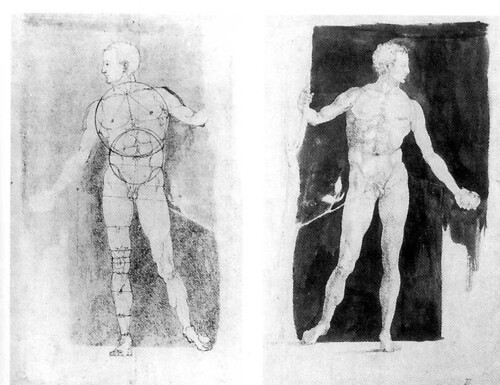
Following up a quote on Thomas Hahn’s site I got a hold of Francois Julien’s The Impossible Nude – Chinese Art and Western Aesthetics.1 Jullien is interested in the question of why the Chinese artistic tradition did not have nudes and, by extension, why the Western tradition was so obsessed with them.

The existence of the nude is made possible primarily by what, which the Greeks, we came to understand by “form”: a form that functions as a model, whose background is often mathematized and geometrized, and takes on the value of an ideal as it fixes an identity of essence (the eidos) -this is what was consecrated by the nude. p.33

Durer

The nude is thus a form in the Platonic sense, “whose contour detaches it from the world and resettles it in itself” (p.75) and always posed (p.78) Chinese artists were always more interested in things in relationship to their surroundings, and thus were always uninterested in painting “mirrored reflections” (which Da Vinci, for one very much wanted to do), avoided poses and instead wanted to capture the “natural” which is seen through interaction.

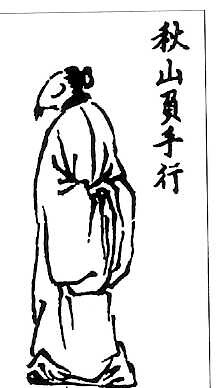
Here is an illustration from the painter’s manual The Mustard Seed Garden, showing a man


Fall Walk

“in the autumn, in the mountains, walking with hands clasped behind his back.” This indicates that the natural context-the setting and the season-which is defined beforehand, but not actually depicted, is considered inseparable from the representation of the figure itself. Otherwise, the critic goes on to say, “the mountain is merely a mountain, and the man is merely a man.”…then the intimacy of their relationship falls apart and the co-originality that the painter was trying to trace….is lost. p.55 Jullien compares the nude to something Chinese artists really liked to paint: rocks. He quotes Su Dongpo “Men, animals, palaces and even tools all have a constant form; on the other hand, mountains, rocks, bamboos, trees, waves or mist have no constant form but nevertheless possess an internal coherence that is constant” Rocks are called ‘cloud-roots’ because they contain just the same active qi as a cloud or a human, and that is what the artist should depict.(p.71)

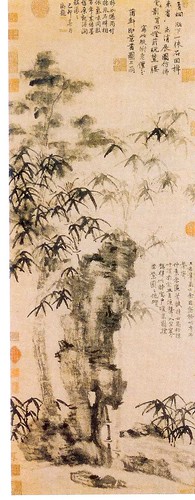
Ni Zan

Here is Ni Zan’s “elegant rock” which “remains blurred, vaguely defined, indistinct.. The mass of concentrated energy is not circumscribed within the form of the rock…and its “form” without being completely individualized is not inconsistent either, contains all forms, or rather it excludes none. (p.77)”It’s a good book, and if you ever wondered why Chinese painting and Western painting did not come together very well in the 20th century you should read it.

.Continue reading →


  1. U of Chicago Press, 2007. It’s a good book, if a little sinological for me.  

Five Things That Didn’t Happen (But Might Have)

Kate Merkel-Hess at China Beat had an intriguing list last month, Five Chinese Historical Events That Don’t Get Much Attention, (2/ 11/08) which was in turn inspired by Jeremiah Jenne’s piece at Jottings From the Granite Studio about the most important Chinese historical figure most people have never heard of.

That got me to thinking – why discriminate against an event just because it didn’t happen? Very un-Daoist. So to kick things off, here are five things that didn’t happen. We don’t mean alleged “failure” to follow European models, such as the once common “failure to modernize,” but turns not taken. You’ll see that they fall into different ontological categories, since there is a lot of wiggle room when it comes to things that don’t exist.


Continue reading →

How things work (in China)

I have been reading a really interesting book on Chinese tools. Well, actually the most interesting thing about it is the title:

Hommel, Rudolf P. China at Work; an Illustrated Record of the Primitive Industries of China’s Masses, Whose Life Is Toil, and Thus an Account of Chinese Civilization,1

You can’t get a much more orientalist sub-title than that. The author spent a lot of time in China between 1921 and 1930 and toured all over Central China photographing and describing Chinese tools. He seems to know a good deal about tools and making stuff, which means he occasionally makes interesting observations about the effectiveness of these tools and comparisons with versions in other countries.2


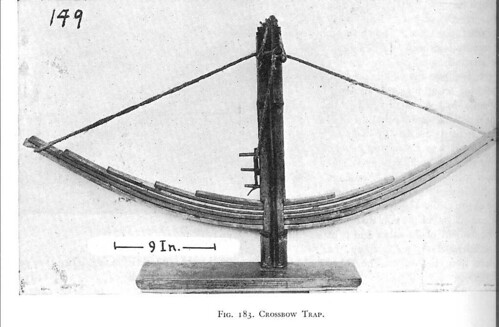
Here in honor of Gary Gygax is a crossbow trap

Crossbow trap


Continue reading →


  1. Cambridge, Mass., M.I.T. Press, 1969. (Re-print of the 1937 edition 

  2. He does tell us that he like the Chinese, and after telling us how to make he explains that this is the origin of the false rumor that Chinese like to eat rotten eggs 

Macroeconomics never gives you more than an overview

Stephen Roach, Chairman of Morgan Stanley Asia has an op-ed in the New York Times (UPDATE: reprinted in Japan Focus) arguing that Japan’s post-bubble recession and fifteen year stagnation may well be what the US economy is facing now. I think he’s right about some of the dangers, but I think he’s leaving out some critical components. Macroeconomics never gives you more than an overview, and I think the situation in the US is much worse.

Roach writes:
Continue reading →

First, kill all the Legalists

Sam at Useless Tree draws our attention to a really interesting website called 新法家(in English the New Legalist) I’m not quite sure who these people are, but the website is out of Beijing and quite impressive. Sam does not much care for them, seeing them as “nationalists who are appropriating ancient Legalist texts, together with some Taoist volumes, to fashion a neo-traditionalist legitimation for a contemporary Chinese assertion of power globally” That sounds about right to me.

Sam is much bothered by their attempts to tie together Legalism and Daoism, but to me it just sounds like Huang-Lao stuff, as there were lots of links between Legalism and Daoism right from the start. I am also not that surprised to find people looking back to the Legalists themselves, as this was a big item in the early 20th century as people began going through the Chinese tradition looking for the genealogy of a modern nation in the Chinese past. The New Legalists may seem weird, but they have a long way to go before they can match up with Kang Youwei.

Of course these people are looking into the past to find something different than the Chinese thinkers of a century ago. They are finding environmentalism and anti-globalization ideas, along with lots of occasions for nationalist chest-thumping. As Sam points out it is pretty bizarre to see Han Fei as a Green. Still they do seem to be drawing on a pretty wide range of classical thought. According to their mission statement

The Chinese people have built up a unique and comprehensive thought system covering medicine, economics and politics. This system aims at a dynamic balance between different parts of the human body, between different groupings of people within a society, and between human society and nature. All its subsystems follow the principle of “guiding changes towards balance” (from The Yellow Emperor’s Four Cannon ) economically, arranging production and consumption in accord with the change of seasons and with nature’s productive capabilities at the time; and politically, allocating limited resources among people according to their respective contributions to the society1

This actually does sound bit like a lot of the Warring States-Han stuff you would find in Mark Edward Lewis’s work. For me the most interesting part is the twisted Marx quote at the end. A lot of the site has an anti-capitalist feel, or at least a feel that China is best off if it does not totally adapt American culture. Part it seems to be vaguely Maoist egalitarianism and concern for the workers, “end capital’s hegemony in the name of liberty” and part of it an even more vague utopianism that owes something to Mao and also a lot various bits of traditional Chinese thought.


  1. 中国人还在这一伟大哲学的基础上建立起了独特的医学、政治、经济体系——她追求人体内部、社会与自然、社会内部各阶层之间 的动态平衡,她的医学、政治、经济都按“应化之道、平衡而止”(《黄帝四经·道法》)的原则构建——经济上,她按照自然时序与产出能力进行生产和消费;政 治上,她按一个人对社会贡献的大小对有限的资源进行配置  

Why is Obama winning?

There are few things I enjoy more than following American elections in the Chinese press. Zaobao (from Singapore) had something recently on Obama and why he is doing so well. Like many foreigners I think they were mystified by this unknown becoming known, but they put some thought into it. They rejected the Clinton camp’s suggestion that his success is entirely attributable to his 花言 (flowery words). After all, many prominent officials and movie stars are supporting him. I get the impression that they think American voters are sheep (which I might be inclined to agree with) but that they also think that American elites are significantly harder to fool (which I really doubt, but then I’m an American not a Confucian). They do point out that as a young man Obama can deal with the grind of the campaign trail, and that he has been successful in raising small amounts of money from lots of people. The one I found most interesting is that they claim that people are worried about American becoming a banana republic if we end up with a Clinton to follow a Bush who followed a Clinton who followed a Bush. I have heard Americans mention that, but I doubt many Democratic primary voters will switch to McCain on that basis. I guess from an Asian perspective that problem jumps out at you more. It’s a nice piece that explains things pretty well. As much as I find some of their thinking odd I wish the American press ran articles on foreign elections that were half as informative.

Mastodon