Beware of Female Spies

I decided to bring you a little Friday night clipping from the archives where, as always, I have my eye open for treason and treachery:

In the Chinese national government archival collection at Taiwan’s Academia Historica there is a small file from the military affairs committee1 dated April, 1938 and entitled:

Take Strict Precautions Against the Enemy’s Female Traitors
嚴防敵人女漢奸

The concise attached brief2 says that, “According to reports, [Japan’s] special services last month began to dispatch [Chinese] trained female traitors to Hankou, Chongqing, Changsha and other cities” who are to conduct intelligence operations against nationalist forces. It recommends a close investigation and special vigilance against these traitors.3


  1. 軍事委員會, is there a better standard translation for this?  

  2. in the form of a 代電 report, then largely repeated in an directive 訓令  

  3. This very short file can be found in 國史館 國民政府檔案 001000005615A (001-071040-0001) 敵情動態, 31-36 (1026-1031).  

Hua Guofeng: Hats Off!

While we wait for Jeremiah at Jottings from the Granite Studio to say something substantive, I’d like to put in another good word for Hua, the man with the goofy smile. I’ve made my share of jokes about him, such as saying that it was strange that the mere governor of a province would think he could move up to the job of running China — why it would be like the governor of say, Georgia or Arkansas thinking that he was qualified to be president of the United States.

But there are important things about him which deserve our respect. The arrest of the Gang of Four was probably the single most important political stroke of its time. During the Cultural Revolution, anybody with power had abused it, but somebody had to take the fall in order to get on with things. When I first went to China, people would say “Gang of Four” and hold up five fingers, the fifth being “he who must not be named.”

That’s pretty obvious, but it was not obvious that Hua would not have the Gang of Four taken out and shot or just “shot while resisting arrest.” The legitimacy of their trial was not that great in procedural terms, though far above Stalin’s show trials of the 1930s and certainly above the secret administrative procedures which condemned hundreds of thousands of Chinese as “rightists” in earlier years. But the basic injustice was that so many other wrongdoers got off. Still, Hua deserves credit for starting on the right foot.

Though it says more about Deng than about Hua, we also need to observe is that after Deng edged him out Hua went on to a quiet career and died in bed. That’s big. Neither of Mao’s two previous successors did — Lin Biao and Liu Shaoqi — and Zhao Ziyang died under house arrest. Being Mao’s successor was like being next in line for a shave from Sweeney Todd, and Hua pulled it off.

So say what you want, China could have done a lot worse than Hua!

Hua Guofeng

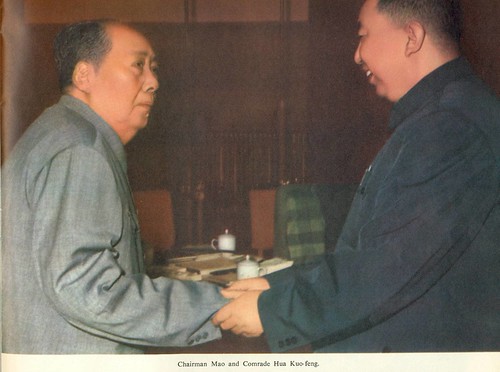
It is not often that a historic figure like Chairman Hua leaves us, and while I can’t possibly compete with Jeremiah in my reverence for the red, red (well, light pink) sun of Chairman Hua, I did think I would post this picture of Hua and Mao that comes from one of my old China Pictorials

I think this was taken close to the end of Mao’s life (from the picture it is hard to tell if it is before or after) and it is something I always use in class when talking about how various people tried to glom on to the old monster’s reputation and power after he was gone. Whatever you say about Hua1 he did get rid of the Gang of Four, which is more good than most politicians have done.


  1. and really, it is pretty sad to have much to say about him 

Lin Yutang and Chinese literature

One of my neighbors was doing some spring cleaning and brought me this.
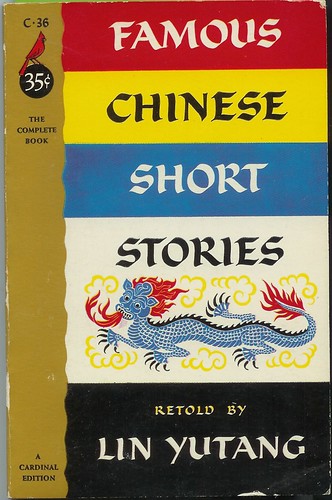
Lin was a notable if somewhat minor intellectual figure in China but his real fame came as an interpreter of China to the outside world. In China he was known as a humorous critic of the warlord governments which got him in trouble with both Left and Right, since they felt warlordism was no joke and his emphasis on the continued value of Eastern Wisdom made him sound more like Tagore than anyone Chinese intelectuals of the period were likely to respect. He became an important figure in the West after Pearl Buck convinced him to write My Country, My People (1935) which launched his career as and interpreter of the West.

He is somewhat unique in that his reputation has vanished almost entirely. His books are still in print, but I don’t think I’ve ever seen one in a bookstore (Although I tend not to haunt the ‘don’t worry be happy section’) and he is never assigned in courses. Even during his life he was dismissed as being someone who wrote English very well. (He was a third-generation Fujian Christian) but was not all that knowledgeable about China. You can see how he worked with these two excerpts from the story Curly-Beard

 [wpcol_1half id=”” class=”” style=””]Lin Yutang:

IT WAS a world of chivalry, adventure, and romance, of plucky battles and faraway conquests, of strange doings of strange men which filled the founding of the great Tang dynasty. Somehow the men of that great period had more stature; their imagination was keener, their hearts were bigger, and their activities more peculiar. Naturally, since the Sui Empire was crumbling, the country was as full of soldiers of fortune as a forest is full of woodchucks. In those days, men gambled their fortunes on high stakes; they matched cunning with cunning and wit against wit. They had their pet beliefs and superstitions, their virulent hatreds and intense loyalties, and once in a while, there was a man of steel with a heart of gold.

It was nine o’clock in the evening. Li Tsing, a young man in his thirties, had finished his supper and was lying in bed, bored, puzzled, and angry at something. He was tall and muscular, with a head of tousled hair set on a handsome neck and shoulders. Lazily he jerked his biceps, for he had a peculiar ability to make these muscles leap up without flexing his arms. He was ambitious, with plenty of energy, and nothing in particular to do.

He had had an interview with General. Yang Su that morning, in which he had presented a plan to save the empire. He was convinced that the fat, old general was not going to read it and regretted having taken the trouble to see him at all. The general, who was in charge of the Western Capital while the Emperor was sporting with women at Nanking, had sat, bland and self-satisfied, on his couch. His face was a mass of pork, with blubbery lips, heavy pouches under his eyes, fat hanging down under his chin and lumpy, distended nostrils, from which sniffs and grunts issued regularly. Twenty pretty young women were lined up on both sides of him, holding cups and saucers, sweetmeats, spittoons, and dusters. The dusters, which were made of hair from horsetails, over a foot long, and fixed with a jade or red- painted wooden handle, were more decorative than useful.

The silky, white horsetails swung gracefully, though idly. There could not be a more convincing picture of a misfit in high office, or a neater contrast between the luxurious setting and the debased sensuality which was no longer capable of enjoying it.

[/wpcol_1half] [wpcol_1half_end id=”” class=”” style=””]
From Cyril Birch Anthology of Chinese Literature

When the Emperor Yang-ti of the Sui dynasty visited Yangchow he left his Western capital, Ch’ang-an, in the charge of Councillor Yang Su. This was a man whom high birth had made arrogant, and in the troubled state of the times he had begun to regard his own power and prestige as unrivalled in the land. He maintained a lavish court and departed from the mode of conduct appropriate to a subject. Whether it was a high officer requesting interview or a private guest paying his respects, Yang would receive his visitor seated on a couch; when he rose to leave his hall it would be to walk, supported on either side by a beautiful girl, down between rows of attendant maidens. In these and other ways he arrogated to himself the imperial prerogatives. With age his behaviour grew more extreme, until he no longer seemed aware of the responsibility he owed to sustain the realm against peril.

One day Li Ching, later to be ennobled as Duke of Wei but at that time still a commoner, requested interview with Yang Su in order to present certain policies to which he had given much thought. As with everyone else, Yang Su remained seated to receive him. But Li Ching came forward, bowed and said, “The whole empire is now in turmoil, as would-be leaders strive for mastery.

Your highness is supreme in the service of our imperial house. Your first concern should be to win the respect of men of heroic mettle, and this you are hindering by remaining seated to receive those who seek audience.”

Yang Su composed his features to an expression of more fitting gravity, rose to his feet and apologized. He derived great pleasure from the discussion which followed, and Li Ching, when the time came for him to withdraw was assured of their acceptance.

[/wpcol_1half_end]

The differences here are pretty stark, and it is easy to see why Lin is not read as much as he used to be. The book is called short stories re-told, so he does not have to stick to the text very closely and there are several versions of the story, but he has changed quite a lot here. The first paragraph of Lin’s version is an introduction to the period and the milieu of dynastic decline in general, which of course would not be needed for a Chinese audience. (I would also not want it in a reading I was assigning, since the whole point is to try to read things the way Chinese would.) Throughout the story Lin adds a lot more dialog and much more detailed descriptions of what people are doing, making his version seem much more like a modern character-driven short story.

The treatment of Yang Su is also interesting. For Chinese readers the minister who exceeds his authority is a well-known enough trope that the Birch version sees no need to dress it up. Lin makes him into an orientalist caricature of the decadent Chinese. (Which may help to explain why Lin was less popular in China.) The whole point of this first story is also changes in Lin’s version. In the Birch version the point of the first encounter is to show our hero, Li Ching, is in fact a hero capable of making others behave better by his own influence. He gets Yang Su to show him proper respect and even manages to get him to agee to his plans (not that anything comes of it). In the Lin version there is not much point to the episode, other than to point out how decadent the Chinese are.

Lin’s story also ends up not having much of a moral. The Birch story rotates around Li Ching and his friend Curly Beard deciding that a Li of Taiyuan is the One Man and rightful next emperor. Li Ching decides to serve him, and Curly Beard, not being that type, decides to go carve himself out a kingdom outside China. This makes it not work so well as a short-story (which it’s not, its a piece of Chinese prose that is short enough to be called one) and so Lin focuses more on Curly-Beard and his friendship with Li Ching. He also gives Li Ching’s wife a much larger role and in general makes the story much more modern. I assume that one of his purposes in doing the translations was to show Western audiences that the Chinese really did have a literary history that paralleled their own. Since editing the Chinese to make them look civilized is not one of the main purposes of translating Chinese literature today, it is not too surprising that Lin is little read.

See also Lin Yutang, Critic and Interpreter Chan Wing-Tsit
College English, Vol. 8, No. 4 (Jan., 1947), pp. 163-169

Documentary on Taiwanese Child Laborers in WWII

SafariScreenSnapz001.jpgA friend of mine here in Taiwan lent me what is probably the best historical documentary I have seen in a long time: 緣的海平線 SHONENKO 臺灣少年工的故事.

Whenever I come across a beautiful work like this, I am reminded of how horrible the vast majority of historical visual material I have seen in the way of television documentaries and other programs on the history of wartime or colonial East Asia. While the rich texture, narrative style, historical research, and quality of the content in this documentary are of the kind we have come to expect in, say, a US Civil War documentary, I wish I could say the same for much of what I have seen in our own field. I can only hope that this documentary can serve as a model to future content creators.

This documentary focuses on the lives of a group of children who were recruited to work in Japanese wartime industry in Japan and tells the story of their hopes, dreams, and the reality of their wartime and postwar suffering. It is mostly in the Taiwanese and occasionally Japanese languages but there are Japanese and English subtitles available.

I was really impressed with the amazing combination of materials they brought together for this high quality production: wartime films, plentiful pictures, primary documents, and interviews of the now elderly Taiwanese and some of the Japanese who interacted with the children (a teacher responsible for recruiting the children, and someone responsible for them in the factory).

The other thing which impressed me with this work was that the message of the program, unlike so many other documentaries on Japan’s war and colonial rule, wasn’t simply to beat the viewer in the head with how evil the Japanese empire was. The narrative is certainly a tragedy but the experience of the children, the deceptive promises of the initial recruitment (familiar surely to many young workers within Japan as well as in the colonies), their disappointment with what met them in Japan, the barbaric conditions of their work, their suffering at the hands of US bombing, and the fate that met them after the war was over all make for, surprise, surprise, a more complex experience that doesn’t lend itself well to a dedicated sermon against anyone or thing in particular. Instead we get a sensitive look at those who lived in and experienced total war, who worked around the clock in factories, repeated daily the exhortations to ever greater wartime production (e.g. 勝つために一機でも一艦でも多く前線へ送れ), who heard the sounds of falling bombs overhead, and then faced the horrors of a chaotic early postwar period in Japan or back to Taiwan or mainland China (as in the fascinating but tragic case of one of the children interviewed).

The Sideshow in Korea?

Yet the costly Iraq war must also be recognised as a sideshow in the Bush global counteroffensive against Islamist militancy, just as the far more costly Korean war was a sideshow to global cold war containment.

So says Edward Luttwak, in an extensive attempt to speed up the process by which History justifies and valorizes the policies of this administration. [via] He’s mostly engaged in a bit of dramatic post hoc, ergo propter hoc whereby a shift in government policies towards extremist Islamic groups is the result of Pres. Bush’s Trumanesque firmness, but the damage done to the success — military and diplomatic — of the initial Afghanistan campaign by the Iraq campaign isn’t taken into account at all.1 The Korean war — which I have a lot of trouble seeing as a “sideshow,” given the direct involvement of Chinese and Russian forces and a lot more actual shooting than in Europe — advanced the cause of anti-communism. It was a success, in the sense that it preserved South Korea as a non-communist state and it was the last full-scale conflict between the great powers for some time. The only sense in which Korea could be called a “sideshow” is that Truman’s containment policy engaged a lot of other parts of the world as well.

He then goes on to mangle Chinese history — Tang, Song and Ming dynasties never conquered anyone, right? — and to cast the future of Asia in binaries (China: convergence or communist collapse? India: corruption stagnation or “traditional” good Brahmin governance?), as well as giving the administration credit for North Korean disarmament instead of noting their years of footdragging on same which have exacerbated the proliferation problem.

Truman deserves better.


  1. He’s also assuming that al Qaeda’s “call to action” attacks were likely to inspire imitators rather than revulsion in the short run, which seems like he’s taking their own rhetoric way too seriously. Romantic nihilists have been claiming that “the masses are on the brink of revolution” and “dramatic action will awaken them” for over two centuries now.  

舊版報紙資訊網: Initial Thoughts and Technical Review

I have been spending a few days looking at one of the important early postwar newspapers in Taiwan, 臺灣新生報, using the microfilm collection on the 6th floor Taiwan resource center of the National Taiwan Library (國立中央圖書館臺灣分館). Yesterday, I happened to catch a glimpse of someone viewing some old copies of another important postwar Taiwan paper, 民報, using an online database, which I will offer some comments about below, following a brief opening rant.

I’m not a big fan of microfilm newspapers. The advantages of this medium over providing access to physical copies or bound printed copies are obvious. Among them include: 1) preservation 2) space conservation 3) the ability to zoom 4) ability to print zoomed in articles from microfilm machines onto various sizes of paper, etc.

However, from the point of view of the historian, the disadvantages soon become apparent: unlike the bound printed copies of, for example, 中央日報, 申報, or 大公報 that I can find in various libraries, which sometimes shrink the original size of the newspaper such that the characters in the articles are barely legible – it is actually possible to browse these through these collections quite fast. It is in fact faster to turn the pages of a book and scan a page of a newspaper for interesting articles than it is to operate the knob of a microfilm machine and zoom in and out on interesting looking pieces.

More importantly, the higher contrast of black text on the printed white of paper makes the experience of looking at bound volumes far more pleasant than a microfilm machine. With the exception of some digital microfilm readers that artificially boost the contrast, the vast majority of microfilm readers I have used in Taiwan, Korea, Japan, and the United States are extremely hard on the eyes. If you have to sit at the reader for 4-10 hours, with some short breaks, for even a few days in a row, the impact on one’s eyes is noticeable. The sick yellow background (or black with white text, as the default is for many newspapers I viewed in Korea’s national library, hardly much better) of the microfilm reader, desperately trying to transfer light to the viewer through its lenses always seems to fall below the expectations of my eyes, which yearn to look at real paper, or even the greater contrast of a computer screen!

Digital databases of newspapers are always welcome. In addition to the power of database searching, they offer some of the benefits of both paper bound and microfilm collections but also some more serious defects. It is not all one glorious march towards progress. In my experience, I have found that digital newspaper collections (as well as many library OPAC databases and other online resources) often are designed by people that appear to greatly underestimate the importance of browsing. It isn’t just about what is there in that article or even on that page; historians often want to know what can be found near that article, page, or issue. Sometimes we aren’t looking for a single article about a single topic, but trying to get a feel for the kinds of things being written on the days and weeks surrounding a particular historical event. It is all part of the task of surveying the discursive environment of a time or place.

Now, having made these comments, let me turn to the database I discovered completely by chance yesterday: 舊版報紙資訊網. Read on below the fold…
Continue reading →

South Korea As Seen from Singapore: The “Korea Boom,” “Korea” Mobilized~

     I can’t resist adding this, my admittedly very superficial observations based on slightly more than two months of residence in Singapore: South Korea, and “Korea” writ large, are indeed a different place when viewed from the perspective of SE Asia.
     The label “Korea” carries with it / connotes at least three meanings here: (1) a small but growing expatriate community of South Koreans on the island (apparently they still retain ROK citizenship if they attain Singapore PR status), currently numbering in the range of 6,000 to 8,000 residents, with a corresponding cultural and material presence (food, DVD’s, business investment, and a shopping mall which has garnered for itself the designation “Little Seoul”); (2) the ongoing popularity of Korean dramas (esp. Choson and Samguk period pieces); and (3) an exotic travel destination, especially in terms of winter sports.   

Of these three, the latter two interest me the most in terms of prior encounters with “Korea Boom” related goods in Japan.  When I was auditing History classes (at Columbia) in 2004, there was a loose thesis circulating among member of one class concerning the popularity of Korean culture in countries with a large ethnic Chinese population, the appeal of watching a once Sino-centric / Confucian (using these very broadly here, I know, and not very carefully) culture undergo rapid change.  That is, the dramas and popular culture might serve as a model to places desirous of undergoing similar changes of their own (China, HK, Singapore). 

  I didn’t devote much thought to this until moving here, discovering that many Singaporeans hold the ROK in high esteem, seeing it as a successful EA nation comparable to their own.  That is, (1) both Singaporeans who desire change might seek to appropriate the ROK model (whatever that is) for their agenda; and likewise, (2) the Singaporean gov.–as well as others in the region–might mobilize a model of change that implies containment, relatively incremental change.  I leave it to the reader to consider here the permutations possible in terms of mobilizing another nation’s recent history for one’s own purposes.

  And this brings me to the third point, those “Dynamic Korea” (sveral years ago) and ‘Korea Sparkiling” ads that run as travel promotions.  They’re conspicuously present on television here–although I haven’t yet paid close attention to which channels, and when they air most frequently–and have succeeded in giving the ROK appeal as a travel destination, particularly in terms of Winter and Skiing.  Of course, these activities do exist as viable options for Koreans, but I never quite conceived of South Korea in terms of a “snow country” while living in Seoul.  I guess that’s partly a product of living just above the Equator . . .

  I’m off to BAKS (British Association Korean Studies) in early September, and looking forward to it as my only previous encounter with KS  in the UK was a 2007 conference at SOAS.

National Taiwan University Library

I’ve started an entry for the NTU Library at the EALA wiki.

Besides the fact that this is a wonderful library by any international standard, I’m really impressed with how open this university library is to visitors. As I explain in the Usage section for the EALA entry, you need only bring a passport or student ID and register at one of the computers near the entry to get a temporary readers card and free wireless login information. The process is even faster and simpler than that at the national libraries in Taiwan, Korea, or Japan. I wish some prominent American university libraries provided such easy access to visitors.

Introduction

Hi,

I’m new to the blog, and just wanted to introduce myself.  I just completed a Ph. D. in the History of Science (2007) on the formation of “state science” in the ROK. 

I’m primarily a Historian of Science / Medicine, with a significant investment in East Asia (South Korea and Japan). I recently started at NUS (National University of Singapore), and will be teaching in the former area (Social History of Disease), while assisting with the latter as we offer our first Korean History classes in Spring 2009. NUS also hired two language lecturers for Korean, and appears to be quite motivated about getting involved with Korean Studies.

In terms of interests, this translates into spending a lot of time in hospitals, and I’m currently working on a book project about the formation / tranformation of a South Korean health care system following the war (1945-1972).

I’m also interested in the messy “in-between” years of about 1945-1965 in terms of the transformation of Korean technology and material culture (engineering, agriculture, the transition from the electrical grid to nuclear power by the late 1970’s), but run into frequent limitations here in terms of a lack of documents.

In any case, I’ll be posting again soon, and look forward to participating–you can also find me at:

  http://www.fas.nus.edu.sg/hist/hisjpd.htm

John

Mastodon